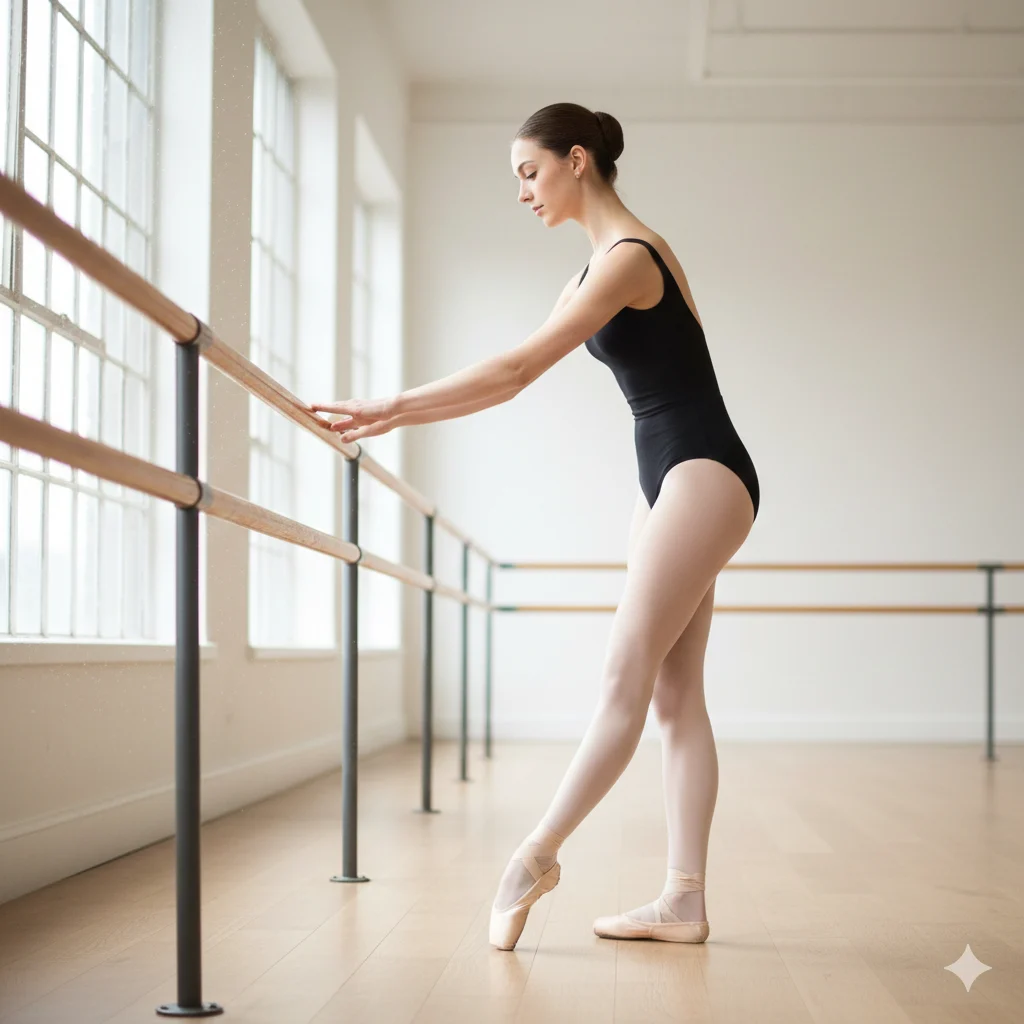
🩰 Ballet move names are the traditional terms for ballet steps, positions, jumps, turns, and poses, including plié, tendu, relevé, pirouette, arabesque, and jeté.
Ever watched a ballet performance and wondered how dancers make every movement look so graceful, precise, and effortless? Behind every elegant step is a specific ballet move name that describes what the dancer is doing. From simple beginner movements to challenging jumps, turns, and poses, ballet has a rich vocabulary that helps dancers learn, practice, and communicate movements clearly.
If you’re searching for ballet move names, you’re in the right place. Many of the most common ballet terms come from French, which can make them seem difficult when you first encounter them. But once you understand what each name means, the movements become much easier to recognize and remember. Plié, tendu, relevé, chassé, pirouette, arabesque, and jeté are just a few famous examples.
Whether you’re a beginner taking your first ballet class, a student improving your technique, a parent helping a young dancer, or simply someone fascinated by ballet, learning these names gives you a clearer understanding of this beautiful art form. You’ll be able to recognize familiar steps, understand ballet instructions, and follow combinations with greater confidence.
In this guide, you’ll discover popular ballet move names from basic positions and everyday steps to impressive turns, jumps, and advanced movements. Each section is designed to make the terminology simple, memorable, and easy to understand.
So, if you’ve ever wanted to know what ballet moves are called and what they actually mean, keep reading. You may be surprised by how many beautiful movements are hidden behind these famous names. 🩰
Foundational Ballet Moves Names at the Barre
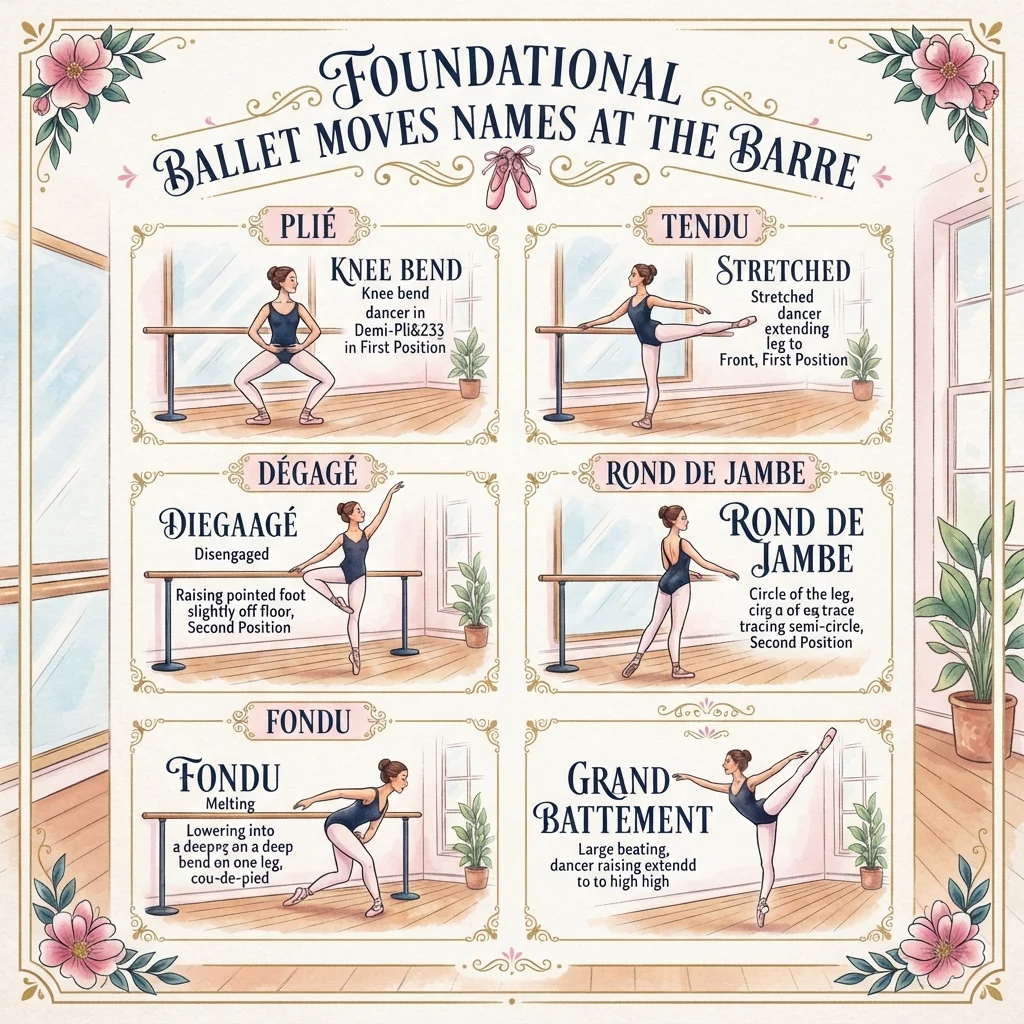
Every ballet class begins at the barre. This is where dancers warm up and build strength. The ballet moves names here are the building blocks for everything else.
Plié (plee-AY)
Meaning: “Bent” or “bending” (French). A smooth bend of the knees while keeping the heels on the floor.
Best for: Warming up the legs, ankles, and feet. It is the preparation and landing for almost every jump.
Tendu (tahn-DEW)
Meaning: “Stretched” (French). The foot brushes along the floor until only the toe is touching, stretching the leg.
Best for: Strengthening the feet and creating a beautiful, pointed toe. It teaches how to move the foot properly.
Dégagé (day-ga-ZHAY)
Meaning: “Disengaged” (French). Similar to a tendu, but the foot brushes off the floor to a small height.
Best for: Building speed and teaching the foot to move quickly and precisely.
Rond de Jambe (rawn duh zhahmb)
Meaning: “Circle of the leg” (French). The toe traces a half-circle on the floor, from front to side to back, or the reverse.
Best for: Loosening the hip joints and creating smooth, controlled movements of the leg.
Relevé (ruh-leh-VAY)
Meaning: “Raised” (French). Rising up onto the balls of the feet (demi-pointe).
Best for: Building strong calf muscles and ankle strength, which is crucial for balance and pointe work.
Essential Center Ballet Moves Names
After the barre, dancers practice in the center of the room without support. These ballet moves names are for balance, coordination, and expression.
The Five Positions of the Feet
This is not a single move but the alphabet of ballet. Every step begins and ends in one of these five positions of the feet (First, Second, Third, Fourth, Fifth).
Port de Bras (por duh brah)
Meaning: “Carriage of the arms” (French). How the arms move gracefully from one position to another.
Best for: Adding beauty, emotion, and flow to the dance. It makes the dancer look like they are floating.
Arabesque (ah-ra-BESK)
Meaning: One of the most famous ballet poses. The dancer stands on one leg with the other leg extended straight behind them.
Best for: Showing off a dancer’s balance, line, and grace. There are several different types of arabesque.
Ballet Technique Names
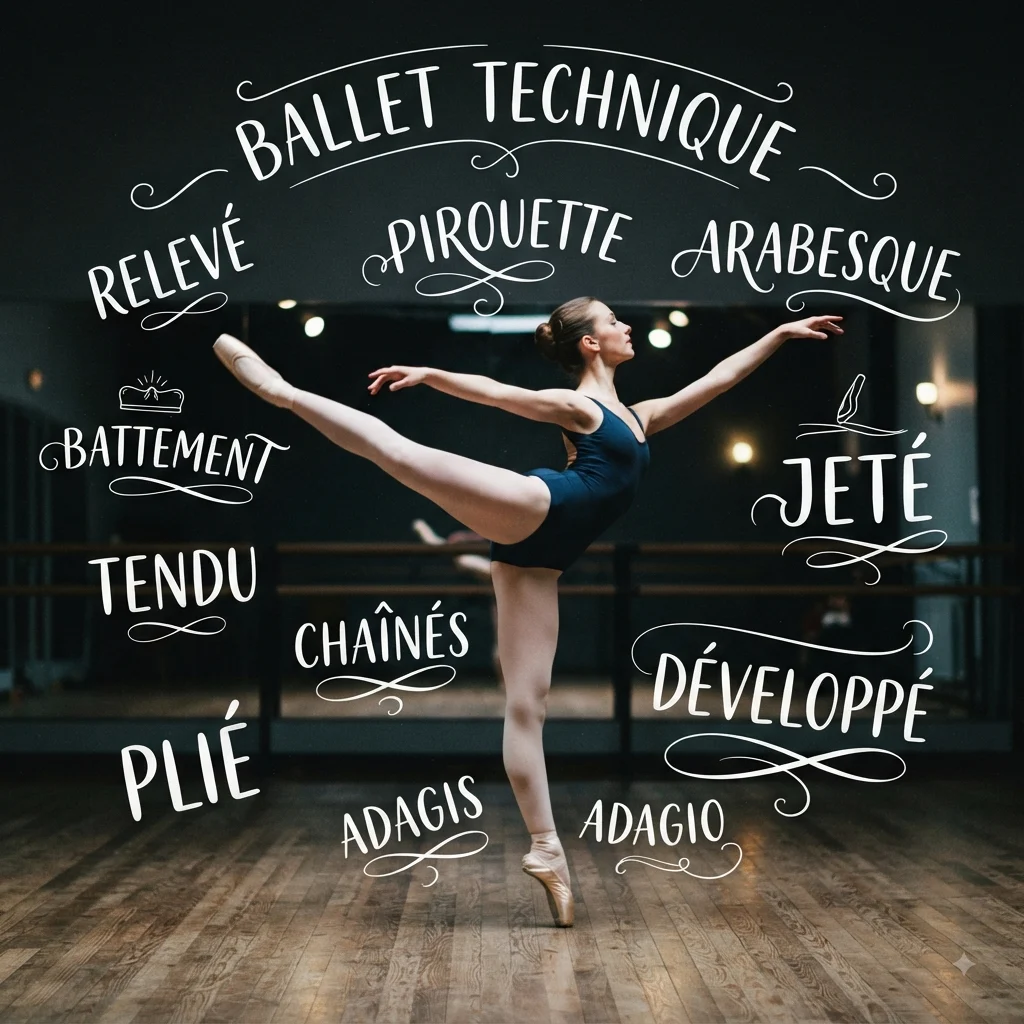
These are the essential building blocks of ballet — the core techniques that every dancer must master for strength, control, and grace.
Plié (plee-AY)
Meaning: Bent. Origin: French. Vibe: Foundational and smooth.
Best for: Warming up the legs and building strength for every jump and landing.
Tendu (tahn-DEW)
Meaning: Stretched. Origin: French. Vibe: Precise and controlled.
Best for: Strengthening the feet and teaching proper alignment.
Dégagé (day-ga-ZHAY)
Meaning: Disengaged. Origin: French. Vibe: Quick and sharp.
Best for: Building speed and precision in the feet.
Rond de Jambe (rawn duh zhahmb)
Meaning: Circle of the leg. Origin: French. Vibe: Flowing and graceful.
Best for: Loosening the hips and improving leg control.
Relevé (ruh-leh-VAY)
Meaning: Raised. Origin: French. Vibe: Strong and elevated.
Best for: Building ankle strength and preparing for pointe work.
Arabesque (ah-ra-BESK)
Meaning: In Arabic style. Origin: French. Vibe: Elegant and expansive.
Best for: Showing balance, line, and grace in a classic pose.
Attitude (ah-tee-TEWD)
Meaning: Pose. Origin: French. Vibe: Dramatic and expressive.
Best for: Creating a beautiful, bent-leg line that adds emotion to movement.
Port de Bras (por duh brah)
Meaning: Carriage of the arms. Origin: French. Vibe: Flowing and expressive.
Best for: Adding grace and emotion through elegant arm movements.
Sauté (soh-TAY)
Meaning: Jumped. Origin: French. Vibe: Light and bouncy.
Best for: Learning the basic technique of jumping and landing softly.
Pirouette (peer-oo-WET)
Meaning: Whirl. Origin: French. Vibe: Controlled and thrilling.
Best for: Mastering balance, spotting, and turning technique.
Ballet Moves Names for Turning
Turns are thrilling to watch and do. These ballet moves names describe the different ways dancers spin.
Pirouette (peer-oo-WET)
Meaning: “Whirl” or “spin” (French). A complete turn of the body on one foot.
Best for: Demonstrating perfect balance, a strong core, and “spotting” (fixing the eyes on one point to avoid dizziness).
Chaînés (sheh-NAY)
Meaning: “Chains” or “links” (French). A series of quick, small turns where the feet stay close together in first position.
Best for: Moving quickly across the stage in a straight line or circle. They look like a sparkling chain of turns.
Piqué Turn (pee-KAY turn)
Meaning: “Pricked” (French). The dancer steps directly onto a straight leg en pointe or demi-pointe and completes a turn.
Best for: Creating sharp, crisp, and direct turns that look very clean and precise.
Ballet Moves Names for Jumping
Jumps, or grands, show a dancer’s power, lightness, and airtime. Here are the key ballet moves names for jumping.
Sauté (soh-TAY)
Meaning: “Jumped” (French). A simple two-footed jump, like a hop, landing in the same position.
Best for: Learning the basic technique of pushing off the floor and landing softly in a plié.
Changement (shahnzh-MAHN)
Meaning: “Changed” (French). A jump starting in fifth position, where the feet quickly switch places in the air before landing.
Best for: Practicing fast footwork and control while in the air.
Assemblé (ah-sahm-BLAY)
Meaning: “Assembled” (French). A jump where one foot brushes out to the side, and both feet come together in the air to land in fifth position.
Best for: A basic traveling jump that teaches the legs to work together.
Grand Jeté (grahn zhuh-TAY)
Meaning: “Big throw” (French). The iconic ballet leap. The dancer takes a running step and throws one leg forward into a split position in the air.
Best for: Creating the magical illusion of flight. It is one of ballet’s most breathtaking moves.
Male Ballet Jumps Names
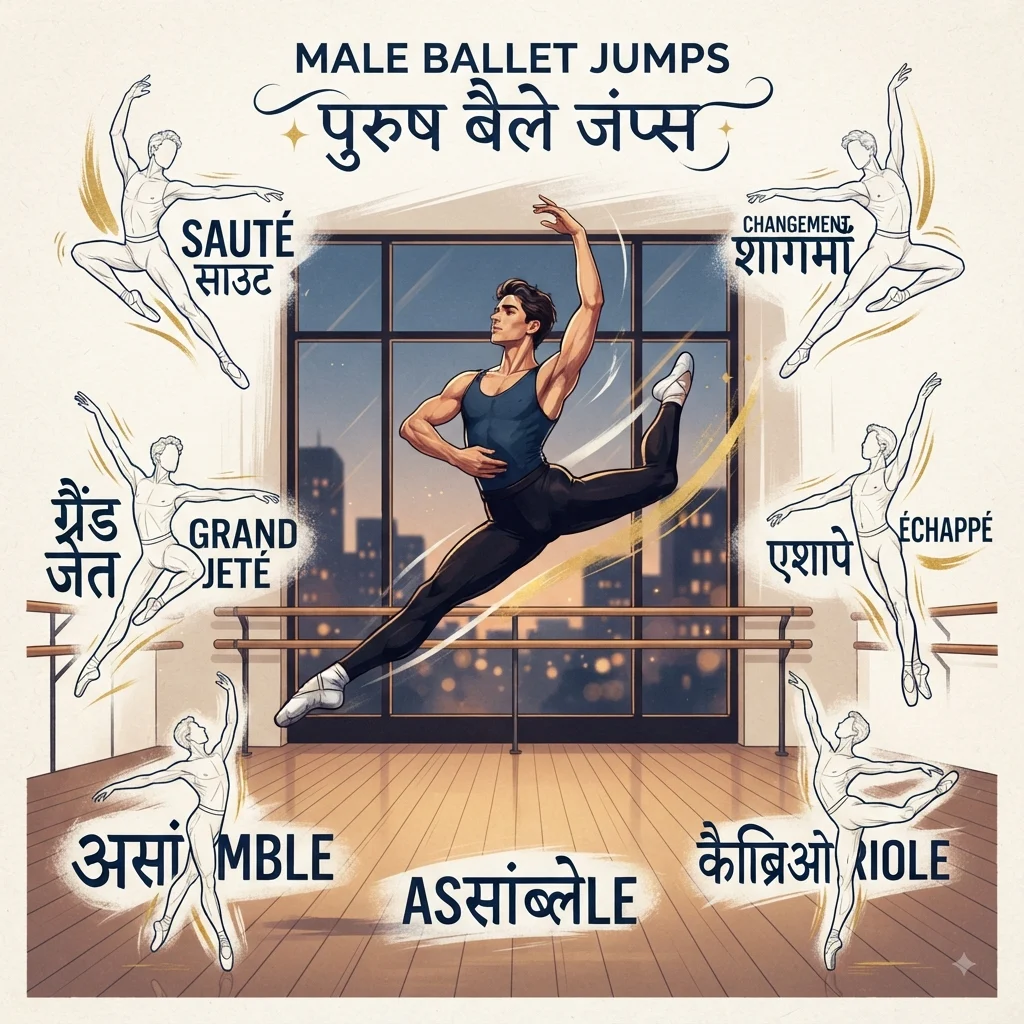
These powerful, soaring jumps showcase strength, height, and masculine grace — perfect for the danseur who commands the stage.
Grand Jeté (grahn zhuh-TAY)
Meaning: Big throw. Origin: French. Vibe: Powerful and soaring.
Best for: A dramatic leap across the stage that looks like flight.
Tour Jeté (toor zhuh-TAY)
Meaning: Thrown turn. Origin: French. Vibe: Bold and commanding.
Best for: A turning leap that shows off strength and control.
Cabriole (ka-bree-OL)
Meaning: Goat-like leap. Origin: French. Vibe: Sharp and impressive.
Best for: A beaten jump where the legs clash mid-air — a show of power.
Sissonne (see-SON)
Meaning: Named after its creator. Origin: French. Vibe: Quick and explosive.
Best for: A jump from two feet landing on one — great for entrances.
Brisé (bree-ZAY)
Meaning: Broken. Origin: French. Vibe: Fast and sparkling.
Best for: A small, traveling beaten jump with quick footwork.
Assemblé (ah-sahm-BLAY)
Meaning: Assembled. Origin: French. Vibe: Clean and precise.
Best for: A jump where both feet come together in the air to land.
Changement (shahnzh-MAHN)
Meaning: Changed. Origin: French. Vibe: Quick and light.
Best for: A jump in fifth position where the feet switch places mid-air.
Sauté (soh-TAY)
Meaning: Jumped. Origin: French. Vibe: Simple and foundational.
Best for: A basic two-footed jump that builds strength and technique.
Ballonné (ba-loh-NAY)
Meaning: Bounced. Origin: French. Vibe: Bouncy and playful.
Best for: A jump that looks light and effortless, like a ball bouncing.
Échappé (ay-sha-PAY)
Meaning: Escaped. Origin: French. Vibe: Sharp and wide.
Best for: A jump from fifth to second position — powerful and open.
Ballet Moves Names for Connecting Steps
These steps are the “glue” that connects bigger jumps and turns. Knowing these ballet moves names helps you see how a dance flows together.
Glissade (glee-SAHD)
Meaning: “Glided” (French). A gliding step that moves sideways, usually to prepare for a bigger jump.
Best for: A small, quick linking step that allows dancers to gain momentum or change direction.
Pas de Bourrée (pah duh boo-RAY)
Meaning: A quick three-step sequence (back, side, front, or other variations) performed on the balls of the feet.
Best for: Creating fast, intricate, and shuffling footwork. It makes dancers look like they are floating.
Ballet Moves Names for Pointe Work
Pointe work is when female dancers dance on the tips of their toes in special shoes. These ballet moves names are often done en pointe.
Échappé (ay-sha-PAY)
Meaning: “Escaped” or “slipped away” (French). Starting in fifth position, the dancer jumps to land with both feet apart in second or fourth position.
Best for: Building strength in the feet and ankles for pointe work. It is a fundamental pointe exercise.
Sur le Cou-de-Pied (sewr luh koo-duh-PYAY)
Meaning: “On the ‘neck’ of the foot” (French). A position where one foot is wrapped around the ankle of the standing leg.
Best for: A common position used in many pointe steps, like relevés and pirouettes, for stability and speed.
Expressive Ballet Moves Names
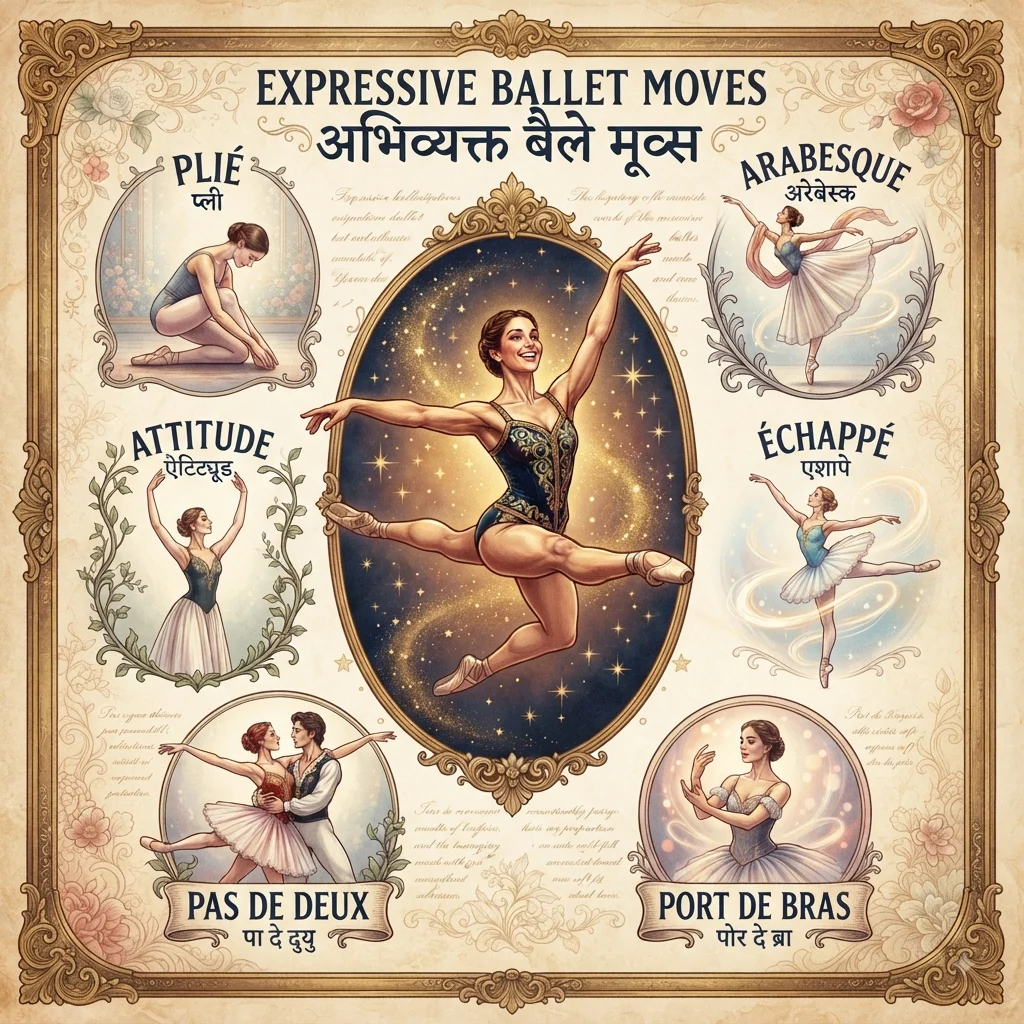
Some ballet moves names are less about technique and more about acting and telling a story.
Attitude (ah-tee-TEWD)
Meaning: A pose where the working leg is lifted to the front, side, or back with the knee beautifully bent.
Best for: Creating a dramatic and expressive look. It is named after a statue of the god Mercury.
Allongé (ah-lon-ZHAY)
Meaning: “Stretched out” or “elongated” (French). An extended line of the arm and body, often from an arabesque.
Best for: Showing longing, reaching, or dramatic emphasis in a story ballet.
Ballet Tricks Names
These aren’t just steps — they’re showstoppers. Flashy, impressive, and guaranteed to make the audience gasp.
Fouetté (fweh-TAY)
Meaning: Whipped. Origin: French. Vibe: Dazzling and powerful.
Best for: A dancer who loves to impress with speed and control.
Tour en l’Air (toor ahn lair)
Meaning: Turn in the air. Origin: French. Vibe: Daring and athletic.
Best for: A male dancer showing off his height and power.
Grand Jeté en Tournant (grahn zhuh-TAY ahn toor-NAHN)
Meaning: Big throw with a turn. Origin: French. Vibe: Epic and breathtaking.
Best for: A dramatic entrance or the climax of a variation.
Piqué Manège (pee-KAY mah-NEZH)
Meaning: Pricked turn in a circle. Origin: French. Vibe: Sharp and commanding.
Best for: A dancer who commands the stage and travels in a circle.
Saut de Chat (soh duh SHAH)
Meaning: Jump of the cat. Origin: French. Vibe: Light and playful.
Best for: A joyful, bouncy leap with a tucked back leg.
Cabriole (kah-bree-OL)
Meaning: Caper, leap. Origin: French. Vibe: Daring and showy.
Best for: A dancer with incredible elevation and leg control.
Entrelacé (ahn-truh-lah-SAY)
Meaning: Interlaced. Origin: French. Vibe: Twisted and impressive.
Best for: A dramatic leap that turns in the air.
Pas de Poisson (pah duh pwah-SOHN)
Meaning: Step of the fish. Origin: French. Vibe: Elegant and arched.
Best for: A graceful, fish-like jump for a soft, floating effect.
Brisé Volé (bree-ZAY voh-LAY)
Meaning: Broken and flying. Origin: French. Vibe: Quick and sparkling.
Best for: A fast, traveling jump with a beating motion.
Grand Jeté Entrelacé (grahn zhuh-TAY ahn-truh-lah-SAY)
Meaning: Interlaced big throw. Origin: French. Vibe: Stunning and dramatic.
Best for: A powerful, turning leap for a dramatic finale.
Fast and Lively Ballet Moves Names
These ballet moves names are for quick, bright, and cheerful dances. They often appear in character pieces or variations.
Brisé (bree-ZAY)
Meaning: “Broken” (French). A small, beating jump where the legs cross like a broken piece of glass.
Best for: Adding quick, sharp, and sparkling accents to a dance. It is a small, traveling jump.
Pas de Chat (pah duh SHAH)
Meaning: “Step of the cat” (French). A jump where the knees are lifted high one after the other, like a cat leaping.
Best for: A light, playful, and bouncy jump that looks joyful and effortless.
Ballet Jumps Names with Pictures
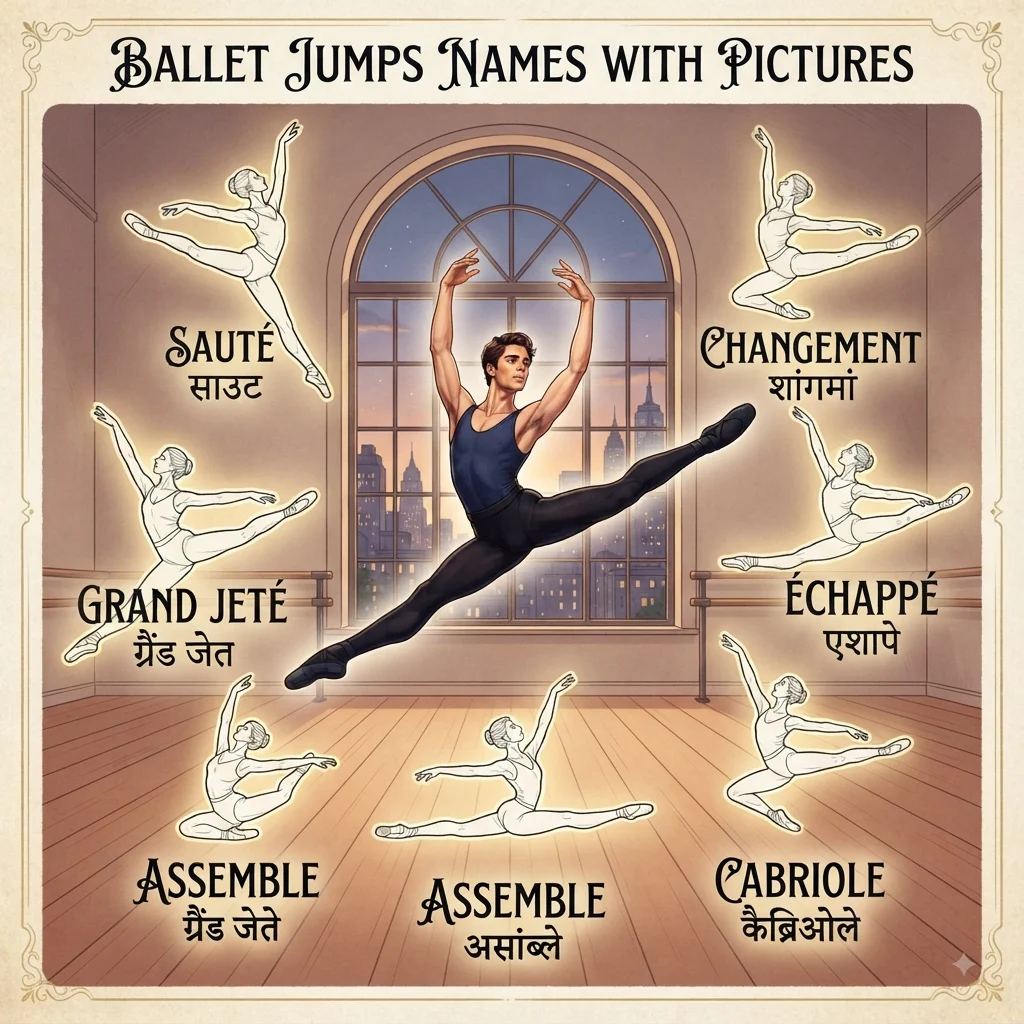
Each jump has a unique look and feel — here’s what to picture when you hear these famous ballet leaps.
Grand Jeté (grahn zhuh-TAY)
Meaning: Big throw. Vibe: Soaring and dramatic.
Picture: A full split in mid-air, arms reaching forward, back leg stretched long behind.
Tour Jeté (toor zhuh-TAY)
Meaning: Thrown turn. Vibe: Powerful and spinning.
Picture: A leap with a half-turn in the air, landing in arabesque with one leg extended behind.
Cabriole (ka-bree-OL)
Meaning: Goat-like leap. Vibe: Sharp and beaten.
Picture: One leg beats against the other mid-air, like a quick scissors snap.
Sissonne (see-SON)
Meaning: Named after its creator. Vibe: Explosive and open.
Picture: Jump from two feet, land on one — like a sudden opening of the body.
Assemblé (ah-sahm-BLAY)
Meaning: Assembled. Vibe: Clean and together.
Picture: One leg brushes out, both meet in the air, and land neatly in fifth position.
Changement (shahnzh-MAHN)
Meaning: Changed. Vibe: Fast and crisp.
Picture: A straight-up jump where feet swap places in the air before landing.
Sauté (soh-TAY)
Meaning: Jumped. Vibe: Simple and bouncy.
Picture: A simple hop in place, landing softly in a plié.
Brisé (bree-ZAY)
Meaning: Broken. Vibe: Sparkling and quick.
Picture: A small, traveling jump with a quick beat of the legs in the air.
Ballonné (ba-loh-NAY)
Meaning: Bounced. Vibe: Light and playful.
Picture: One leg lifts to the side, then both meet in the air like a bouncing ball.
Échappé (ay-sha-PAY)
Meaning: Escaped. Vibe: Sharp and wide.
Picture: Jump from closed fifth position to open second position — legs spring apart.
Large and Traveling Ballet Moves Names
These ballet moves names cover a lot of stage space. They are big, bold, and often used for entrances or dramatic moments.
Tour Jeté (toor zhuh-TAY)
Meaning: “Thrown turn” (French). A large, turning leap where the dancer starts with the back to the audience, turns in the air, and lands in an arabesque.
Best for: A powerful, masculine jump that shows off great height and control. It is also called a grand jeté en tournant.
Failli (fah-YEE)
Meaning: “Giving way” or “sinking” (French). A preparatory step where the dancer transfers weight quickly, often seeming to “fall” onto one foot before a jump.
Best for: Creating a sense of momentum and drama before a big leap like a grand jeté.
Dance Leaps Names
These leaps are the heart of ballet — powerful, graceful, and full of flight. Perfect for any dancer looking to soar across the stage.
Grand Jeté (grahn zhuh-TAY)
Meaning: Big throw. Origin: French. Vibe: Soaring and breathtaking.
Best for: A dramatic leap that shows power, height, and beautiful split extension.
Saut de Chat (soh duh SHAH)
Meaning: Cat’s jump. Origin: French. Vibe: Light and playful.
Best for: A springy leap where the front leg lifts high with a bent knee, like a cat pouncing.
Tour Jeté (toor zhuh-TAY)
Meaning: Thrown turn. Origin: French. Vibe: Powerful and dramatic.
Best for: A turning leap that starts with the back to the audience and lands in arabesque.
Assemblé (ah-sahm-BLAY)
Meaning: Assembled. Origin: French. Vibe: Clean and precise.
Best for: A jump where both legs come together in the air and land in fifth position.
Pas de Chat (pah duh SHAH)
Meaning: Step of the cat. Origin: French. Vibe: Bouncy and joyful.
Best for: A light leap where knees are lifted high one after the other.
Glissade (glee-SAHD)
Meaning: Glided. Origin: French. Vibe: Smooth and connecting.
Best for: A small gliding leap that prepares for bigger jumps.
Chassé (sha-SAY)
Meaning: Chased. Origin: French. Vibe: Bright and traveling.
Best for: A sliding leap where one foot “chases” the other through the air.
Brisé (bree-ZAY)
Meaning: Broken. Origin: French. Vibe: Sharp and sparkling.
Best for: A small, beating leap that adds quick accents to a dance.
Failli (fah-YEE)
Meaning: Giving way. Origin: French. Vibe: Dramatic and flowing.
Best for: A preparatory leap that creates momentum before a big jump.
Sissonne (see-SON)
Meaning: Named after its creator. Origin: French. Vibe: Strong and controlled.
Best for: A leap from two feet that lands on one foot, showing control and power.
Mime and Story Ballet Moves Names
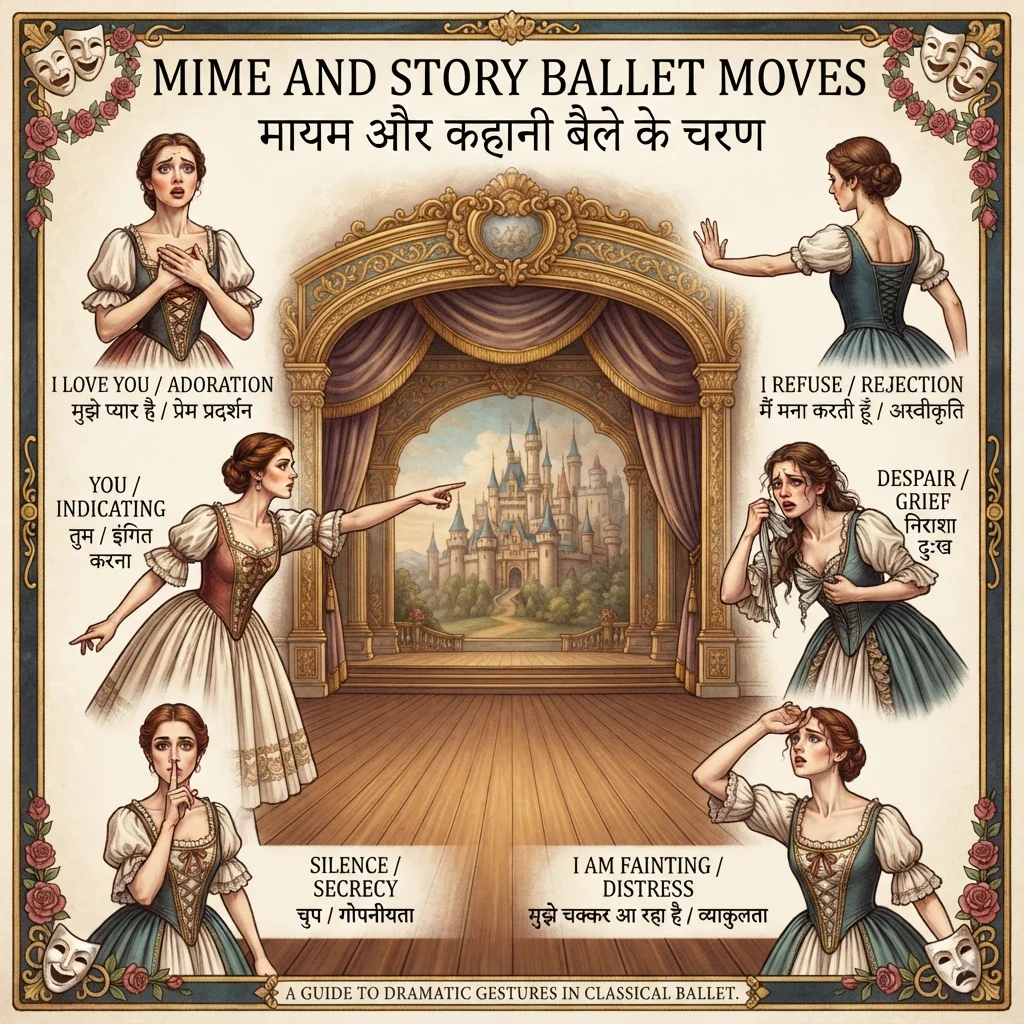
In classical story ballets like Swan Lake or Giselle, dancers use traditional mime gestures. These are a special set of ballet moves names for the hands and face.
“I Love You” / “We Are in Love”
Gesture: The dancer points to their eye, then crosses both hands over the heart, then points to the person they are addressing.
Best for: Clearly telling the story of love between characters without using words.
“Dance With Me” / “Will You Marry Me?”
Gesture: The dancer circles their hands around each other in front of their body, then gestures with an open palm toward the other person.
Best for: An invitation, often used by princes to ask for a dance or to propose marriage in fairy-tale ballets.
Ballet Lifts Names
These are the breathtaking moments in ballet where one dancer lifts another into the air — creating magic, trust, and stunning visual poetry on stage.
Fish Dive (FISH DIVE)
Meaning: A dramatic lift where the ballerina arches backward like a fish leaping from water. Origin: Ballet. Vibe: Daring and beautiful.
Best for: A dramatic, trust-filled moment in a pas de deux.
Shoulder Sit (SHOUL-der SIT)
Meaning: The ballerina sits on her partner’s shoulder, supported by his hands. Origin: Ballet. Vibe: Elegant and poised.
Best for: A regal, statuesque pose showing perfect balance.
One-Handed Lift (WUN-HAN-did LIFT)
Meaning: The partner lifts the ballerina using only one hand — a true test of strength. Origin: Ballet. Vibe: Powerful and impressive.
Best for: Showing off incredible strength and control.
Two-Handed Lift (TOO-HAN-did LIFT)
Meaning: A classic lift using both hands for maximum support and control. Origin: Ballet. Vibe: Steady and graceful.
Best for: A beautiful, sweeping moment of trust and partnership.
Press Lift (PRESS LIFT)
Meaning: The partner lifts the ballerina straight up above his head using arm strength alone. Origin: Ballet. Vibe: Strong and commanding.
Best for: A dramatic, show-stopping moment in any performance.
Swan Lift (SWAN LIFT)
Meaning: A graceful lift inspired by the iconic poses from Swan Lake. Origin: Ballet. Vibe: Ethereal and romantic.
Best for: A flowing, lyrical moment in a classical ballet.
Arabesque Lift (ah-ra-BESK LIFT)
Meaning: The ballerina is lifted while holding an arabesque pose in the air. Origin: Ballet. Vibe: Stunning and elegant.
Best for: Showing perfect line and extension while off the ground.
Overhead Lift (OH-ver-hed LIFT)
Meaning: The ballerina is lifted completely above the partner’s head. Origin: Ballet. Vibe: Daring and impressive.
Best for: A dramatic, eye-catching moment in a performance.
Supported Leap (suh-POR-ted LEEP)
Meaning: The partner helps the ballerina achieve extra height and distance in a jump. Origin: Ballet. Vibe: Effortless and floating.
Best for: Creating the illusion of flight and weightlessness.
Pendulum Lift (PEN-juh-lum LIFT)
Meaning: The ballerina is swung like a pendulum through her partner’s arms. Origin: Ballet. Vibe: Flowing and dramatic.
Best for: A sweeping, dynamic moment that moves across the stage.
Advanced Ballet Moves Names
These are the impressive, jaw-dropping moves that professional dancers master after years of training — big leaps, multiple turns, and breathtaking feats of strength and control.
Grand Jeté (grahn zhuh-TAY)
Meaning: Big throw. Origin: French. Vibe: Powerful and soaring.
Best for: A dramatic leap across the stage that looks like flying.
Fouetté (fweh-TAY)
Meaning: Whipped. Origin: French. Vibe: Dazzling and demanding.
Best for: The famous 32 turns in Swan Lake — a true test of stamina.
Tour en l’Air (toor ahn lair)
Meaning: Turn in the air. Origin: French. Vibe: Bold and impressive.
Best for: A powerful jump with a full turn in the air, often done by male dancers.
Grand Pirouette (grahn peer-oo-WET)
Meaning: Big spin. Origin: French. Vibe: Commanding and controlled.
Best for: A dramatic, multiple-turn spin that stops on a dime.
Grand Pas de Deux (grahn pah duh DUH)
Meaning: Big step for two. Origin: French. Vibe: Romantic and show-stopping.
Best for: The grand finale of a ballet — a duet full of lifts and leaps.
Ballonné (ba-loh-NAY)
Meaning: Bounced. Origin: French. Vibe: Light and bouncy.
Best for: A jump that looks effortless and springy, showing off great control.
Cabriole (ka-bree-OL)
Meaning: Goat-like leap. Origin: French. Vibe: Sharp and powerful.
Best for: A leap where one leg beats against the other in the air.
Entrechat (ahn-truh-SHAH)
Meaning: Interweaving. Origin: French. Vibe: Quick and precise.
Best for: A jump where the feet beat together multiple times in the air.
Sissonne (see-SON)
Meaning: Named after the Duke of Sissonne. Origin: French. Vibe: Elegant and wide.
Best for: A jump from two feet to one foot, landing in a beautiful pose.
Attitude (ah-tee-TEWD)
Meaning: Pose. Origin: French. Vibe: Dramatic and expressive.
Best for: A striking pose with a bent leg held high — pure artistry.
Ballet References
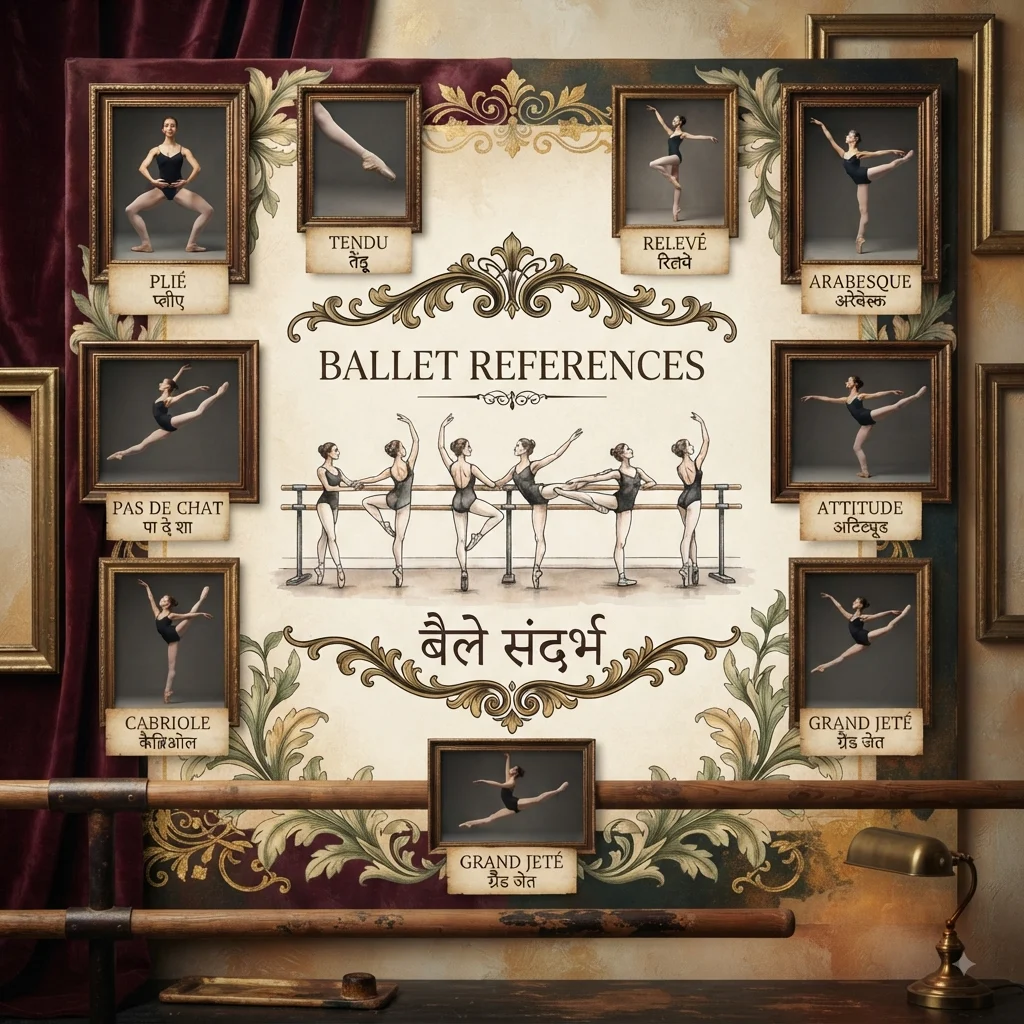
These are the classic ballet works, characters, and cultural touchstones that every ballet lover should know — from iconic performances to legendary roles.
Swan Lake (SWON LAYK)
Meaning: Famous ballet about a princess turned into a swan. Origin: Russian. Vibe: Tragic and romantic.
Best for: A timeless story of love, betrayal, and magical transformation.
The Nutcracker (NUT-krak-er)
Meaning: Classic Christmas ballet. Origin: Russian. Vibe: Whimsical and festive.
Best for: A magical holiday tradition filled with sweets, snow, and wonder.
Giselle (ji-ZEL)
Meaning: Romantic ballet about a peasant girl. Origin: French. Vibe: Haunting and poetic.
Best for: A heartbreaking story of love, betrayal, and forgiving spirits.
Sleeping Beauty (SLEE-ping BYOO-tee)
Meaning: Fairy tale ballet. Origin: Russian. Vibe: Elegant and grand.
Best for: A lavish production with stunning costumes and triumphant finale.
Odette (oh-DET)
Meaning: White Swan. Origin: French. Vibe: Graceful and tragic.
Best for: The quintessential ballerina role — fragile, pure, and doomed.
Odile (oh-DEEL)
Meaning: Black Swan. Origin: French. Vibe: Seductive and fierce.
Best for: The dazzling villainess who steals the show with 32 fouettés.
Prince Siegfried (SEEG-freed)
Meaning: Swan Lake’s hero. Origin: German. Vibe: Noble and conflicted.
Best for: A prince who must choose between love and duty.
Coppélia (koh-PEL-yah)
Meaning: Comedic ballet about a toymaker. Origin: French. Vibe: Light and playful.
Best for: A charming, funny ballet with mechanical dolls and mistaken identities.
Don Quixote (don kee-HOH-tay)
Meaning: Ballet based on the classic novel. Origin: Spanish. Vibe: Energetic and colorful.
Best for: A vibrant ballet full of Spanish flair, passion, and show-stopping leaps.
Fouetté (fweh-TAY)
Meaning: Whipped turn. Origin: French. Vibe: Spectacular and demanding.
Best for: The legendary 32 turns that steal the show in Swan Lake.
Conclusion:
Learning these ballet moves names is like getting a key to a secret world. It helps new dancers follow instructions and grow. It helps audiences see the incredible skill behind the beauty. From the simple plié at the barre to the soaring grand jeté across the stage, every term has a purpose. Next time you watch a ballet, see how many of these ballet moves names you can recognize. It will make your experience even more magical.
(FAQ)
1. What is the first ballet move a beginner learns?
The first ballet move a beginner learns is the plié. It is the most basic movement for warming up and is part of almost every other step.
2. What is the most famous ballet turn?
The most famous ballet turn is the pirouette. It is a classic, complete spin on one foot that requires excellent balance.
3. Why are all the ballet moves names in French?
Ballet was officially developed and codified in the French royal courts in the 17th century, so the original French terminology for ballet moves names is still used worldwide today.
4. What is the big leap in ballet called?
The big, split leap in ballet is called the grand jeté. It is one of the most recognizable and breathtaking ballet moves names.
5. What are the five basic positions called in ballet?
They are simply called First Position, Second Position, Third Position, Fourth Position, and Fifth Position. They are the essential foundation for all other ballet moves names.