
Spoke or Spoken are two forms of the verb “speak,” used differently in English grammar depending on tense and sentence structure.
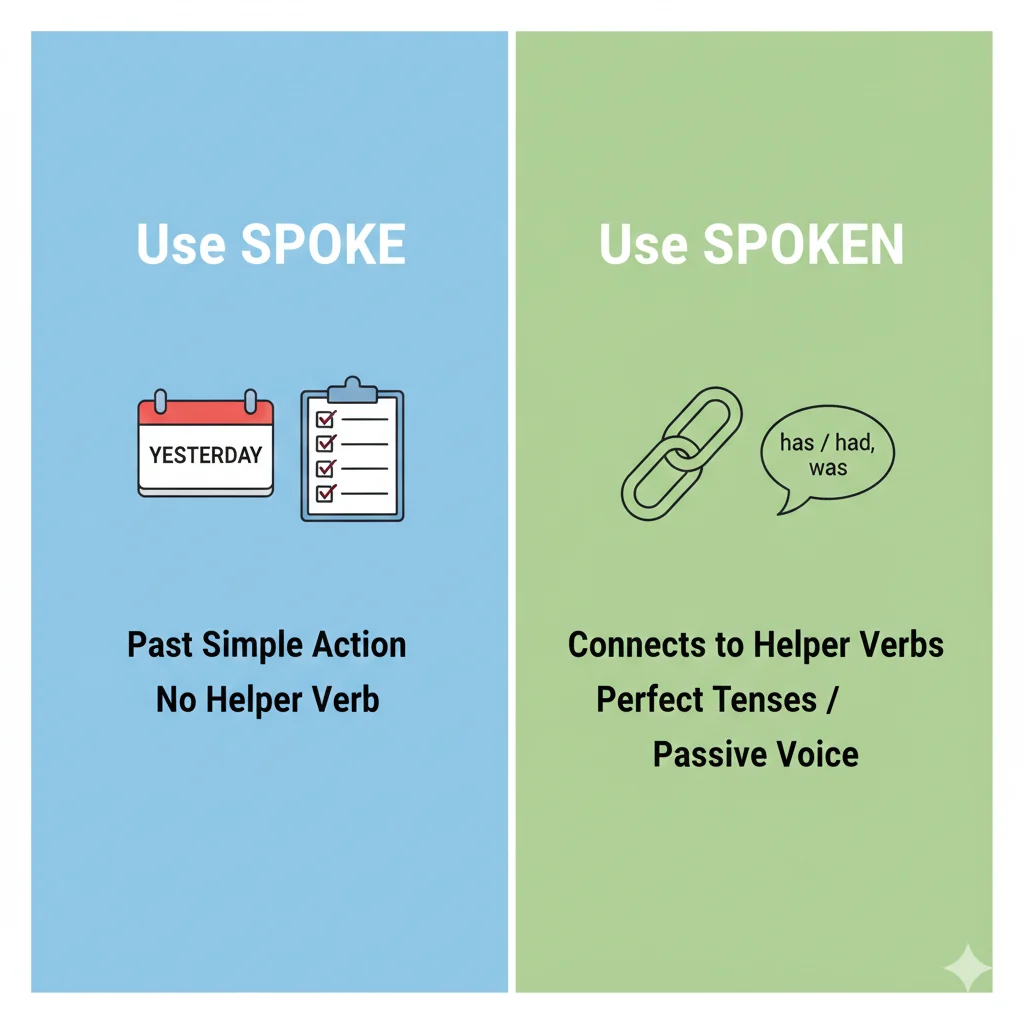
Simply put, “spoke” is the past simple form used for actions completed in the past, while “spoken” is the past participle form used with helping verbs like has, have, or had to show a completed action. For example, “She spoke to him yesterday” (past simple) and “She has spoken to him already” (present perfect).
The main difference is very simple: “spoke” is used alone in past actions, while “spoken” is always used with auxiliary verbs. This rule helps you choose the correct form in writing and speaking without confusion.
For more clarity, here are extra examples:
- He spoke very clearly during the meeting.
- They have spoken about this issue many times.
- I had spoken to her before the event started.
Understanding spoke vs spoken is important for improving English grammar, sentence accuracy, and communication skills. Once you learn this difference, you can avoid common mistakes and write or speak more naturally.
In short: “spoke” = past simple action, “spoken” = perfect tense with helping verbs.
Spoke or Spoken meaning
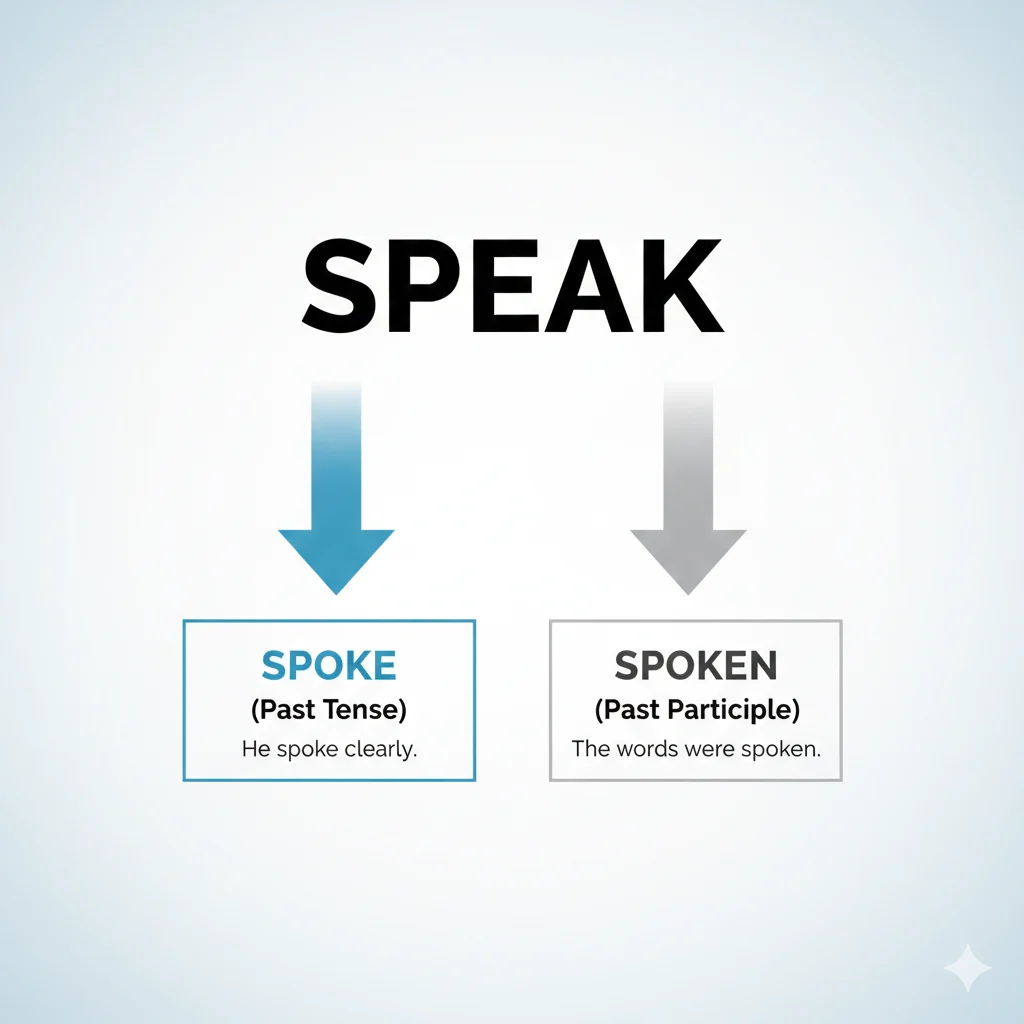
“Spoke” is the simple past tense. “Spoken” is the past participle. You use “spoke” when talking about a completed action in the past. You use “spoken” with helper verbs like “have,” “has,” “had,” or “was.”
- Spoke (Simple Past): “She spoke to me yesterday.” (The action is finished.)
- Spoken (Past Participle): “She has spoken to me already.” (Used with “has.”)
- Spoken (Past Participle): “The words were spoken clearly.” (Used with “were.”)
The Origin of Spoke / Spoken
The words “spoke” and “spoken” come from the Old English verb “specan” or “sprecan,” which meant to speak. English, like many languages, has a group of irregular verbs that don’t form their past tense by adding “-ed.” These verbs often come from very old root words that were used frequently. “Speak” belongs to a pattern of irregular verbs that change their middle vowel. This pattern is called ablaut. You see it in similar verbs: sing/sang/sung, drive/drove/driven, break/broke/broken. Over centuries, “speak” evolved into its modern forms: spoke for the simple past and spoken for the past participle. This historical development is why we have spelling differences today—it’s a linguistic fossil preserved in our everyday speech.
British English vs American English Spelling
For the verb “speak,” the past tense forms “spoke” and “spoken” are identical in both British and American English. There is no spelling variation like with “colour/color” or “realise/realize.” The core grammar rule is universal. However, slight differences in pronunciation might occur, but the written word remains the same. This consistency makes mastering “spoke” and “spoken” easier for learners worldwide. The real challenge lies in using the correct form (past tense vs. past participle) in sentences, which follows the same grammatical structure in both dialects.
Which Spelling Should You Use?
Your choice isn’t about spelling but about grammatical form. The rule is standard globally:
- Use “spoke” for the simple past tense. (Example: I spoke, you spoke, they spoke.)
- Use “spoken” when you need the past participle, which always comes with a helper verb (has/have/had, is/was/are/were). (Example: I have spoken, it was spoken.)
- For US English: Follow the rule above. “I spoke” is correct. “I have spoken” is correct.
- For UK/Commonwealth English: The rule is exactly the same. No difference.
- For Global/Formal Writing (Business, Academia): Always use “have/has/had spoken” for perfect tenses. Using “have spoke” is considered incorrect and can undermine your professional image.
Common Mistakes with Spoke / Spoken
The most frequent error is using “spoke” where “spoken” is required, especially with helper verbs. This is often due to analogy with regular verbs (like “walked”).
- Incorrect: “I have spoke to the manager.”
- Correct: “I have spoken to the manager.” (Past participle with “have”)
- Incorrect: “She had spoke about it before.”
- Correct: “She had spoken about it before.” (Past participle with “had”)
- Incorrect: “It was spoke in confidence.”
- Correct: “It was spoken in confidence.” (Past participle with “was”)
- Confusing “Speak” with “Say” or “Talk”: While related, their past forms differ: say/said, talk/talked. Don’t mix them.
Spoke / Spoken in Everyday Examples
Seeing words in context is the best way to learn. Here’s how “spoke” and “spoken” appear naturally across different formats:
- Email (Professional): “As we spoke about in our meeting, I have now spoken with the legal team and attached their feedback.”
- News Headline: “Prime Minister Spoke at UN Summit; Rare Languages Spoken in Region Documented.”
- Social Media (Casual): “Just spoke with my best friend for hours! Haven’t spoken like that in ages. #heartfelt”
- Formal Writing/Report: “The witness spoke clearly. Having spoken under oath, her testimony was entered into the record.”
- Everyday Conversation: “Who spoke?” vs. “Who has spoken?” The first asks about a past event. The second asks about who has taken a turn so far.
Spoke / Spoken – Google Trends & Usage Data
Analysis of search data for “spoke vs spoken” and related terms shows consistent, global interest. Searches remain steady year-round, spiking during academic periods in English-speaking countries like the US, UK, India, and the Philippines. This pattern aligns with students and learners seeking grammar help. The specific phrase “I have spoke” is often searched as a question, indicating users are checking if their intuitive phrasing is correct. This data confirms the ongoing need for clear, authoritative, and accessible explanations on this topic. It tells us that in 2026, providing a direct answer that satisfies both immediate user intent (a quick correction) and deeper learning (the underlying rule) is crucial for content to perform well.
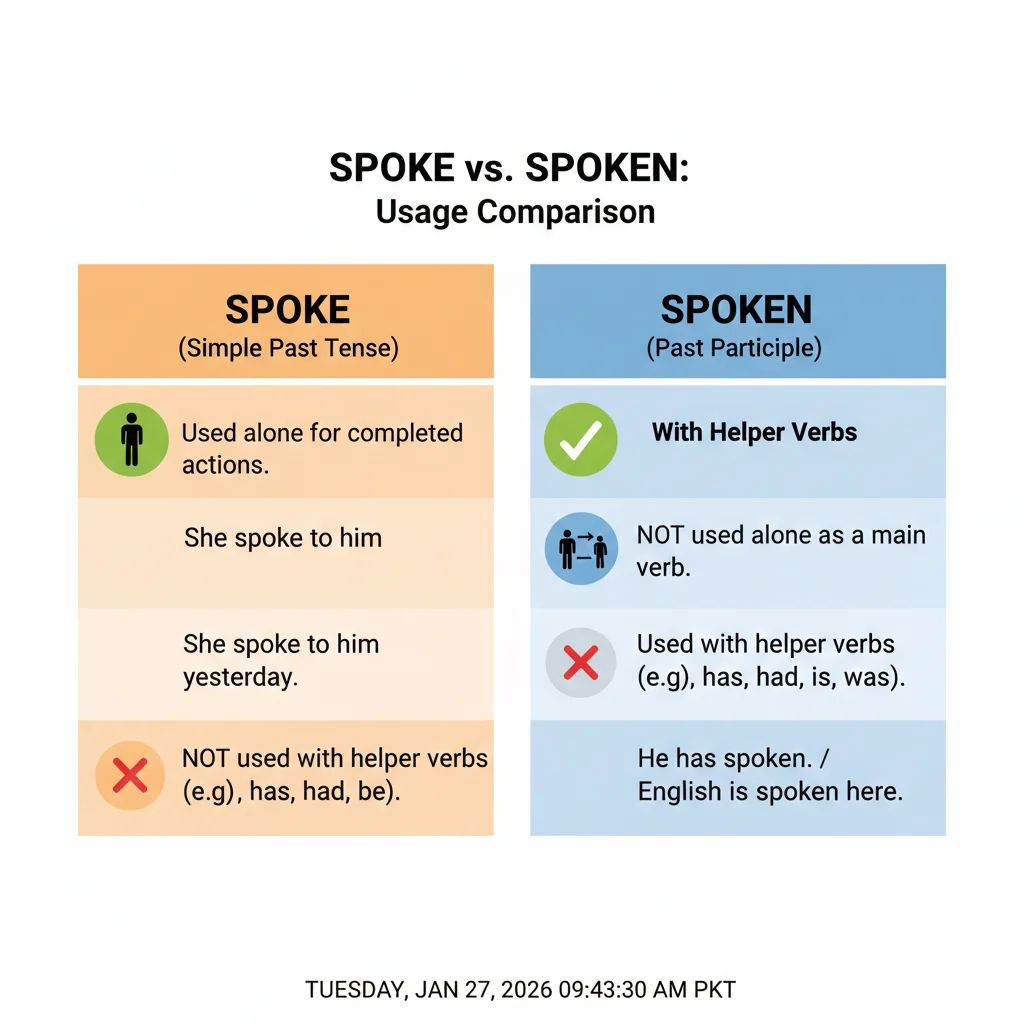
Comparison Table:
| Feature | Spoke | Spoken |
|---|---|---|
| Verb Form | Simple Past Tense | Past Participle |
| Used With | Stands alone (no helper) | Helper Verbs (has, have, had, is, was, etc.) |
| Example 1 | He spoke loudly. | He has spoken loudly. |
| Example 2 | They spoke yesterday. | They had spoken before the event. |
| Key Question | Did the action happen in the past? | Is the action connected to the present or another past event? |
FAQs on Spoke and Spoken
1. Which is correct, “spoken” or “spoke”?
Both are correct, but in different contexts. Use “spoke” for simple past actions. Use “spoken” with verbs like “have,” “has,” or “was.”
2. What is the past tense of “spoken”?
“Spoken” is itself a past form (the past participle). The simple past tense is “spoke.” So, you don’t need a past tense of “spoken.”
3. Is it “just spoken” or “just spoke”?
It depends. “I just spoke” is correct for a very recent, completed action (common in US English). “I have just spoken” is also correct and more common in UK English. Avoid “I just spoken.”
4. What are the 4 skills in English?
The four core language skills are Listening, Speaking, Reading, and Writing. “Spoke” and “spoken” relate directly to the speaking skill.
5. Why do people say “no can do”?
“No can do” is an informal, idiomatic phrase meaning “I can’t do that.” It mimics non-native or simplified speech patterns and is not standard grammar. It’s unrelated to the correct use of “spoke/spoken.”
6. I see “Spoke Spoken English” apps. What does it mean?
These are language learning apps focusing on spoken English—teaching you how to speak the language. The name plays on the verb forms to emphasize conversational practice.
7. What does “I speak, spoke, spoken” mean?
This is a common way to list the three main parts of the irregular verb “speak”: present (speak), simple past (spoke), and past participle (spoken). It’s a learning aid for grammar.
Conclusion
Mastering the difference between “spoke” and “spoken” is a small grammar rule with a significant impact on your clarity and credibility in English. Remember the core principle: “spoke” stands alone for past actions, while “spoken” always needs a helper verb like “have,” “has,” or “was.” This rule is consistent across both American and British English, making it a universal standard.
By understanding this, you avoid common errors like “I have spoke” and can confidently construct sentences for any context—be it a quick email, a social media post, or a formal report. As you continue to improve your English, pay attention to other irregular verbs (like break/broke/broken or write/wrote/written), as they follow similar patterns. Keep practicing by reading and listening to how native speakers use these forms. With this knowledge, you can ensure your spoken and written English is always accurate and effective, meeting the communication demands.

Norman Lewis was a British writer famed for his brilliant travel journalism, sharp cultural insight, and classics like Naples ’44 and Voices of the Old Sea.