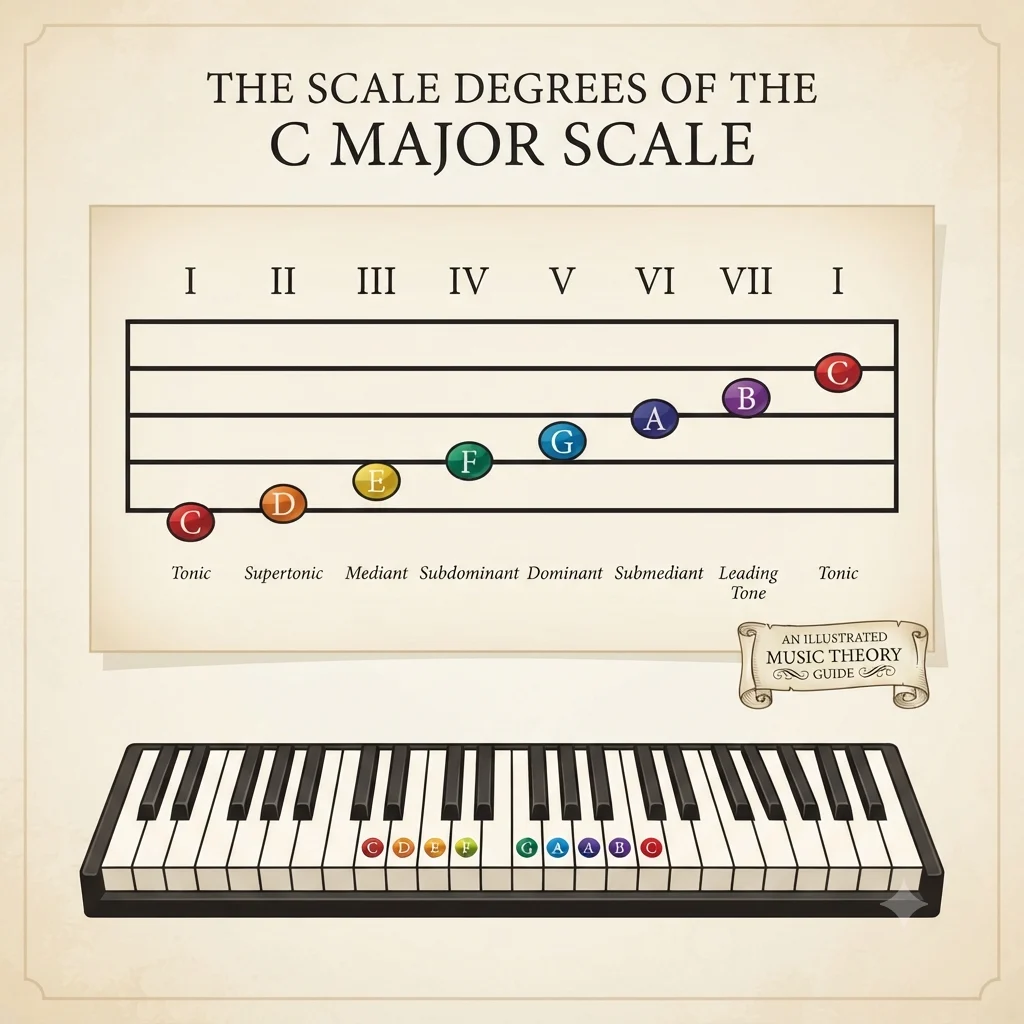
Scale Degree Names: Scale degree names are the names assigned to each note of a musical scale according to its position. The seven scale degree names are Tonic (1st), Supertonic (2nd), Mediant (3rd), Subdominant (4th), Dominant (5th), Submediant (6th), and Leading Tone or Subtonic (7th), each playing a unique role in melody, harmony, and chord progressions.
Every melody is built from notes, but understanding what each note does is the key to mastering music theory. Scale degree names help musicians recognize how notes function within a major or minor scale, making it easier to read sheet music, build chords, create melodies, understand intervals, and analyze chord progressions. Whether you’re learning piano, guitar, singing, composing, or studying music for the first time, knowing these names provides a strong foundation for every musical skill.
Musicians, teachers, students, and composers around the world rely on scale degree names because they make musical concepts easier to understand and communicate. From the stability of the tonic to the tension created by the leading tone, each scale degree has a specific purpose that shapes the sound and emotion of a piece of music. As one of the fundamental concepts taught in music theory, learning these names gives beginners greater confidence while helping experienced musicians perform, compose, and analyze music more effectively.
In this guide, you’ll discover all scale degree names, their meanings, functions, and practical examples, along with simple explanations that are easy to follow. Whether you’re studying for a music exam, improving your theory knowledge, or learning a new instrument, you’ll quickly understand how each scale degree works and gain the confidence to apply these concepts in every song you play, write, or perform.
What Are Scale Degrees?
Scale degrees are the positions of notes in a scale. Each note gets a number and a special name.
Tonic
- Meaning: (TON-ik) The first and most important note. The home base.
- Best for: The note that gives the scale its name and key.
Supertonic
- Meaning: (SOO-per-ton-ik) The second note. One step above the tonic.
- Best for: A note that often leads to the tonic or mediant.
Mediant
- Meaning: (MEE-dee-ant) The third note. Halfway between tonic and dominant.
- Best for: A note that helps determine if the scale is major or minor.
Subdominant
- Meaning: (Sub-DOM-in-ant) The fourth note. Below the dominant.
- Best for: A note that creates movement and tension.
Dominant
- Meaning: (DOM-in-ant) The fifth note. Very important and strong.
- Best for: A note that strongly wants to resolve to the tonic.
Submediant
- Meaning: (Sub-MEE-dee-ant) The sixth note. Below the mediant.
- Best for: A note that adds color and emotion to the scale.
Leading Tone
- Meaning: (LEE-ding Tone) The seventh note. Leads up to the tonic.
- Best for: A note that creates a strong pull back to the home note.
Tonic
- Meaning: (TON-ik) The first and last note. The center of the scale.
- Best for: The note that feels like home and resolution.
Octave
- Meaning: (OK-tiv) The eighth note. The same as tonic but higher.
- Best for: The note that completes the scale and starts over.
Subtonic
- Meaning: (Sub-TON-ik) A seventh note that is a whole step below the tonic.
- Best for: A note that is less strong than the leading tone.
The Tonic – The Home Base
The tonic is the most important note in any scale. It is the center of gravity.
Tonic
- Meaning: (TON-ik) The first note. The key center of the music.
- Best for: The note that feels like home and resolution.
The Tonic’s Role
- Meaning: Everything in the music relates to the tonic.
- Best for: Understanding where the music begins and ends.
Tonic Chord
- Meaning: The chord built on the tonic note.
- Best for: Feeling like the music has come home.
Key Center
- Meaning: Another name for the tonic. The note that gives the key its name.
- Best for: Knowing what key a piece of music is in.
Final Note
- Meaning: The note where most songs end. Usually the tonic.
- Best for: Feeling that the music has finished properly.
Resting Point
- Meaning: The tonic is the most stable note.
- Best for: Understanding where music feels resolved.
Home Note
- Meaning: A simple way to describe the tonic.
- Best for: Beginners learning about scales.
Scale Anchor
- Meaning: The tonic anchors the entire scale.
- Best for: Understanding why other notes move toward the tonic.
Tonal Center
- Meaning: Another way to say tonic or key center.
- Best for: Advanced music theory discussions.
Root
- Meaning: Sometimes used to mean tonic, especially in chords.
- Best for: Understanding how chords are built.
The Supertonic – The Second Note
The supertonic is one step above the tonic. It is a useful and common note.
Supertonic
- Meaning: (SOO-per-ton-ik) The second degree of the scale.
- Best for: A note that often moves to the tonic or mediant.
Supertonic Role
- Meaning: One step above the tonic. Often leads to the tonic.
- Best for: Creating movement in melodies.
Supertonic Chord
- Meaning: The chord built on the second note.
- Best for: Used in many common chord progressions.
Passing Note
- Meaning: The supertonic often works as a passing note.
- Best for: Moving smoothly between other notes.
Scale Degree 2
- Meaning: The second position in the scale.
- Best for: Counting and understanding scale positions.
Step Above Tonic
- Meaning: One whole or half step above the home note.
- Best for: Understanding intervals in music.
Next Note
- Meaning: The note that comes after the tonic.
- Best for: Beginners learning scale patterns.
Pivot Note
- Meaning: The supertonic can pivot to different chords.
- Best for: Understanding harmonic movement.
Neighbor Note
- Meaning: The supertonic often acts as a neighbor to the tonic.
- Best for: Creating simple melodic patterns.
Approach Note
- Meaning: A note that approaches the tonic from above.
- Best for: Understanding melodic resolution.
The Mediant – The Third Note
The mediant is exactly halfway between the tonic and the dominant. It is very important.
Mediant
- Meaning: (MEE-dee-ant) The third degree of the scale.
- Best for: A note that determines major or minor.
Mediant’s Role
- Meaning: Halfway between tonic and dominant.
- Best for: Giving the scale its major or minor quality.
Major or Minor
- Meaning: The mediant decides if the scale is major or minor.
- Best for: Understanding the mood of the music.
Mediant Chord
- Meaning: The chord built on the third note.
- Best for: Creating the I, IV, V progression.
Key Determiner
- Meaning: The mediant helps determine the key.
- Best for: Figuring out if music is happy or sad.
Scale Degree 3
- Meaning: The third position in the scale.
- Best for: Counting and learning scale positions.
Tone Determiner
- Meaning: The mediant sets the tone of the scale.
- Best for: Understanding musical emotion.
Third Note
- Meaning: The simple name for the mediant.
- Best for: Beginners learning about scales.
Chord Builder
- Meaning: The mediant is part of the main chord.
- Best for: Building major and minor chords.
Emotional Note
- Meaning: The mediant creates the emotional feel of the music.
- Best for: Understanding major (happy) vs minor (sad).
The Subdominant – The Fourth Note
The subdominant is below the dominant. It is the second most important note in harmony.
Subdominant
- Meaning: (Sub-DOM-in-ant) The fourth degree of the scale.
- Best for: A note that creates motion and tension.
Subdominant’s Role
- Meaning: Below the dominant. Prepares for the dominant.
- Best for: Understanding common chord progressions.
Subdominant Chord
- Meaning: The chord built on the fourth note.
- Best for: Creating the subdominant sound.
Fourth Note
- Meaning: The simple name for the subdominant.
- Best for: Beginners learning scale positions.
Tension Note
- Meaning: The subdominant creates some tension.
- Best for: Understanding musical tension and release.
Scale Degree 4
- Meaning: The fourth position in the scale.
- Best for: Counting and understanding patterns.
Harmonic Support
- Meaning: The subdominant supports the dominant.
- Best for: Building chord progressions.
Stepping Stone
- Meaning: The subdominant leads to the dominant.
- Best for: Understanding harmonic movement.
Bridge Note
- Meaning: The subdominant bridges the tonic and dominant.
- Best for: Creating smooth chord progressions.
Plagal Note
- Meaning: The subdominant is used in the plagal cadence.
- Best for: Understanding the “Amen” cadence.
The Dominant – The Most Powerful Note
The dominant is the fifth note. It has a strong pull back to the tonic.
Dominant
- Meaning: (DOM-in-ant) The fifth degree of the scale.
- Best for: A note that strongly wants to resolve to the tonic.
Dominant’s Role
- Meaning: Creates the strongest pull back to home.
- Best for: Understanding tension and resolution.
Dominant Chord
- Meaning: The chord built on the fifth note.
- Best for: Creating the V chord in progressions.
Fifth Note
- Meaning: The simple name for the dominant.
- Best for: Beginners learning scale patterns.
Tension Creator
- Meaning: The dominant creates musical tension.
- Best for: Understanding why music feels unresolved.
Scale Degree 5
- Meaning: The fifth position in the scale.
- Best for: Counting and learning scale degrees.
Resolution Note
- Meaning: The dominant resolves strongly to the tonic.
- Best for: Understanding cadences and endings.
Perfect Fifth
- Meaning: The dominant is a perfect fifth above the tonic.
- Best for: Understanding intervals in music.
V Chord
- Meaning: The dominant chord is called the V chord.
- Best for: Understanding roman numeral analysis.
Home Stretch
- Meaning: The dominant leads back to home.
- Best for: Understanding musical phrases.
The Submediant – The Sixth Note
The submediant is below the mediant. It adds color and emotion to the music.
Submediant
- Meaning: (Sub-MEE-dee-ant) The sixth degree of the scale.
- Best for: A note that adds emotional color.
Submediant’s Role
- Meaning: Below the mediant. Adds warmth and color.
- Best for: Creating emotional depth in music.
Submediant Chord
- Meaning: The chord built on the sixth note.
- Best for: Creating the vi chord in progressions.
Sixth Note
- Meaning: The simple name for the submediant.
- Best for: Beginners learning scale positions.
Emotional Note
- Meaning: The submediant adds feeling to music.
- Best for: Understanding mood and emotion.
Scale Degree 6
- Meaning: The sixth position in the scale.
- Best for: Counting and learning patterns.
Relative Minor
- Meaning: The submediant is the relative minor key.
- Best for: Understanding minor keys.
Color Note
- Meaning: The submediant adds color to music.
- Best for: Creating beautiful melodies.
Warm Note
- Meaning: The submediant has a warm, gentle sound.
- Best for: Soft, emotional music.
vi Chord
- Meaning: The submediant chord is called the vi chord.
- Best for: Understanding roman numeral analysis.
The Leading Tone – The Tension Creator
The leading tone is the seventh note. It creates the strongest pull to the tonic.
Leading Tone
- Meaning: (LEE-ding Tone) The seventh degree of the scale.
- Best for: A note that strongly wants to move up to the tonic.
Leading Tone’s Role
- Meaning: Leads up to the tonic. Creates strong tension.
- Best for: Understanding how melodies resolve.
Leading Tone Chord
- Meaning: The chord built on the seventh note.
- Best for: Creating the vii chord in progressions.
Seventh Note
- Meaning: The simple name for the leading tone.
- Best for: Beginners learning scale positions.
Tension Note
- Meaning: The leading tone creates the most tension.
- Best for: Understanding musical suspense.
Scale Degree 7
- Meaning: The seventh position in the scale.
- Best for: Counting and learning scale degrees.
Half Step Below Tonic
- Meaning: The leading tone is a half step below the tonic.
- Best for: Understanding intervals and resolution.
Pulling Note
- Meaning: The leading tone pulls up to the tonic.
- Best for: Understanding melodic movement.
vii Chord
- Meaning: The leading tone chord is called the vii chord.
- Best for: Understanding roman numeral analysis.
Climax Note
- Meaning: The leading tone creates a musical climax.
- Best for: Building to exciting moments in music.
The Subtonic – The Flattened Seventh
The subtonic is like the leading tone but a whole step below the tonic.
Subtonic
- Meaning: (Sub-TON-ik) The seventh degree in natural minor scales.
- Best for: A note that is a whole step below the tonic.
Subtonic’s Role
- Meaning: A whole step below the tonic. Less tense than leading tone.
- Best for: Understanding minor scale harmony.
Flattened Seventh
- Meaning: The subtonic is a flattened leading tone.
- Best for: Understanding natural minor scales.
Seventh Note in Minor
- Meaning: The subtonic is used in minor scales.
- Best for: Understanding major vs minor differences.
Scale Degree 7 (Minor)
- Meaning: The seventh position in the natural minor scale.
- Best for: Learning minor scale patterns.
Weaker Pull
- Meaning: The subtonic has a weaker pull than the leading tone.
- Best for: Understanding minor key harmony.
Whole Step Below
- Meaning: The subtonic is a whole step below the tonic.
- Best for: Understanding intervals in minor keys.
Natural Minor
- Meaning: The subtonic is used in the natural minor scale.
- Best for: Understanding the natural minor scale.
Folk Music Note
- Meaning: The subtonic is common in folk music.
- Best for: Understanding different musical styles.
Modal Note
- Meaning: The subtonic is used in musical modes.
- Best for: Understanding modes and scales.
Scale Degrees and Chords
Scale degrees are used to build chords. Each chord gets a number and name.
Tonic Chord
- Meaning: The I chord. Built on the first note.
- Best for: The home chord where music starts and ends.
Supertonic Chord
- Meaning: The ii chord. Built on the second note.
- Best for: A common chord that leads to the dominant.
Mediant Chord
- Meaning: The iii chord. Built on the third note.
- Best for: A chord that bridges the tonic and dominant.
Subdominant Chord
- Meaning: The IV chord. Built on the fourth note.
- Best for: The second most common chord in music.
Dominant Chord
- Meaning: The V chord. Built on the fifth note.
- Best for: The most important chord besides the tonic.
Submediant Chord
- Meaning: The vi chord. Built on the sixth note.
- Best for: The relative minor chord of the key.
Leading Tone Chord
- Meaning: The vii chord. Built on the seventh note.
- Best for: A chord that creates strong tension.
Roman Numerals
- Meaning: The way chords are labeled using Roman numerals.
- Best for: Understanding harmonic analysis.
Major Chords
- Meaning: Chords that sound happy. Often I, IV, V.
- Best for: Understanding major key harmony.
Minor Chords
- Meaning: Chords that sound sad. Often ii, iii, vi.
- Best for: Understanding minor key harmony.
Scale Degrees in Major and Minor
The scale degrees change slightly between major and minor keys.
Major Scale Degrees
- Meaning: Tonic, Supertonic, Mediant, Subdominant, Dominant, Submediant, Leading Tone.
- Best for: Understanding major scale harmony.
Natural Minor Degrees
- Meaning: Tonic, Supertonic, Mediant, Subdominant, Dominant, Submediant, Subtonic.
- Best for: Understanding natural minor scale harmony.
Harmonic Minor
- Meaning: A minor scale with a raised leading tone.
- Best for: Creating stronger tension in minor keys.
Melodic Minor
- Meaning: A minor scale with raised sixth and seventh.
- Best for: Creating smooth melodies in minor keys.
Mediant Differences
- Meaning: The third is lowered in minor scales.
- Best for: Understanding why minor sounds sad.
Dominant Differences
- Meaning: The dominant is often the same in major and minor.
- Best for: Understanding harmonic similarities.
Leading Tone Differences
- Meaning: Minor scales often use the subtonic instead.
- Best for: Understanding minor key harmony.
Scale Comparison
- Meaning: Comparing major and minor scale degrees.
- Best for: Learning the differences between scales.
Chord Differences
- Meaning: Major and minor scales create different chords.
- Best for: Understanding harmony in different keys.
Key Signatures
- Meaning: How scale degrees change with key signatures.
- Best for: Reading and understanding written music.
Conclusion
Scale degree names are essential for any musician. They help you understand how music works. Scale degree names like Tonic, Supertonic, Mediant, Subdominant, Dominant, Submediant, and Leading Tone describe each note’s role in a scale.
Whether you are a beginner or an advanced musician, knowing these names helps you communicate with others. The best musical scale terms give you a language to talk about music. They help you understand chords, melodies, and harmony.
Think about the music you play or listen to. Can you hear the tonic? Can you feel the dominant pulling back home? The best scale degree names are the ones you use every day in your music. Learn them, use them, and enjoy making music.
(FAQS)
Q1: What are the seven scale degree names?
A: The seven names are Tonic, Supertonic, Mediant, Subdominant, Dominant, Submediant, and Leading Tone.
Q2: What is the most important scale degree?
A: The Tonic is the most important. It is the home note of the scale.
Q3: Why is it called the Dominant?
A: It is called Dominant because it is the most important note after the tonic. It “dominates” harmony.
Q4: What is the difference between Leading Tone and Subtonic?
A: The Leading Tone is a half step below the tonic. The Subtonic is a whole step below. Leading Tone is used in major scales, Subtonic in natural minor scales.
Q5: How do scale degrees help with music theory?
A: Scale degrees help you understand chords, intervals, and how music moves. They are the building blocks of music theory.

Hilda Hulme was a literary scholar known for her sharp research, influential writings, and valuable contributions to English language and historical literature studies.