
Have you ever paused while typing, wondering if it’s esthetically or aesthetically? This common spelling dilemma trips up writers, students, and professionals daily.
People search for this keyword to find a quick, authoritative answer and to understand which version to use in their work, emails, or social media. Is one spelling a mistake, or are both acceptable? This confusion often stems from differences between American and British English.
This article will clear the fog completely. We’ll explore the word’s origin, compare spelling rules, and give you clear, audience-based advice. By the end, you’ll know exactly when to use each spelling to ensure your writing looks aesthetically pleasing and professionally polished.
This guide is designed to solve user intent, offering a quick answer first, followed by a detailed yet simple explanation that aligns with current language use.
Aesthetically
The quick answer is that both esthetically and aesthetically are correct, but they belong to different dialects. “Aesthetically” (with an “a”) is the standard spelling in British English and is used widely in most English-speaking countries. “Esthetically” (without the “a”) is a common variant in American English. For example:
- “The room was aesthetically designed.” (Common globally)
- “The procedure offers an esthetically pleasing result.” (Common in the US)
The core aesthetically pleasing meaning relates to beauty and artistic principles. The choice depends on your audience.
The Origin of Aesthetically
To understand the spelling difference, we must look at the word’s origin. “Aesthetic” comes from the Greek word “aisthētikos,” meaning “perceptive, sensitive, related to sense perception.” The Latinized version is “aestheticus.” The initial “ae” digraph is key. When the word entered English in the 18th century, it kept this classical “ae” spelling (aesthetic). However, American English has a long history of simplifying spellings from other languages. A notable reform championed by Noah Webster promoted spellings like “color” (instead of colour) and “center” (instead of centre). This movement also favored simplifying “ae” to just “e” in many words—hence esthetic emerged as a standard American variant. So, the spelling difference isn’t an error but a reflection of linguistic evolution on different continents.
British English vs American English Spelling
The core rule is simple: British English prefers the “ae” (aesthetic), while American English often accepts the simplified “e” (esthetic). This pattern applies to related words too.
Examples in a sentence:
- Aesthetic (BrE/Common): “She has a great aesthetic sense.”
- Esthetic (AmE): “The dentist specializes in esthetic dentistry.”
Other words following this pattern:
- Anaemia (BrE) vs Anemia (AmE)
- Paediatric (BrE) vs Pediatric (AmE)
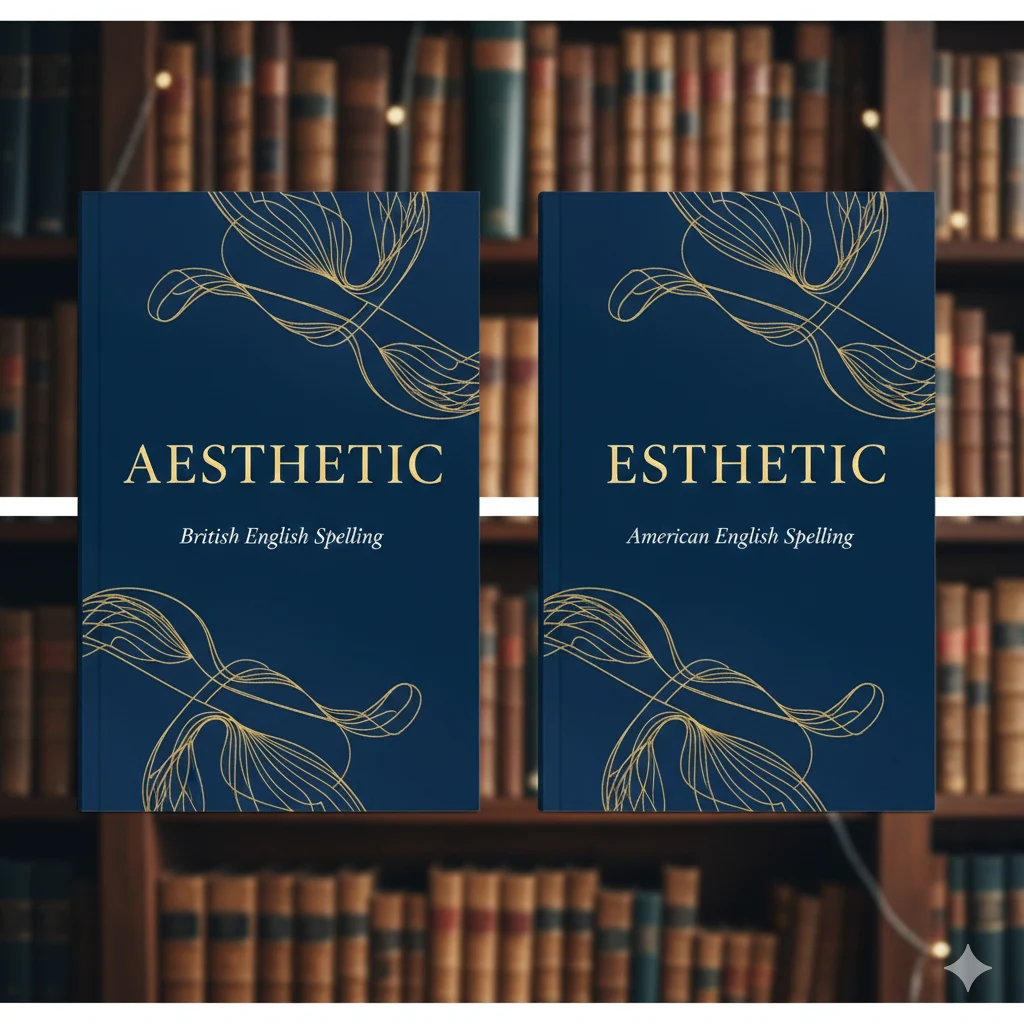
Comparison Table:
| Word Variant | Preferred Region | Example Usage |
|---|---|---|
| Aesthetic, Aesthetically | United Kingdom, Canada, Australia, Commonwealth nations, Global English. | “The gallery’s layout is aesthetically innovative.” |
| Esthetic, Esthetically | United States. Less common internationally. | “They offer esthetic skin treatments.” |
Which Spelling Should You Use?
Your audience should guide your choice naturally.
- For a US Audience: “Esthetically” is perfectly correct and widely understood. However, “aesthetically” is also very common and not considered wrong. Using “aesthetically” can be a safe, universally recognized choice even in the US.
- For a UK/Commonwealth/Global Audience: Always use “aesthetically.” Using “esthetically” here may be viewed as a spelling error or an overly Americanized form.
- For Formal/International Writing (Academic, Business, Web): Default to “aesthetically.” It is the more universally accepted form globally. It ensures your document maintains a professional and widely recognizable standard.
Common Mistakes with Aesthetically
The most frequent errors stem from the tricky “ae” and “e” sounds.
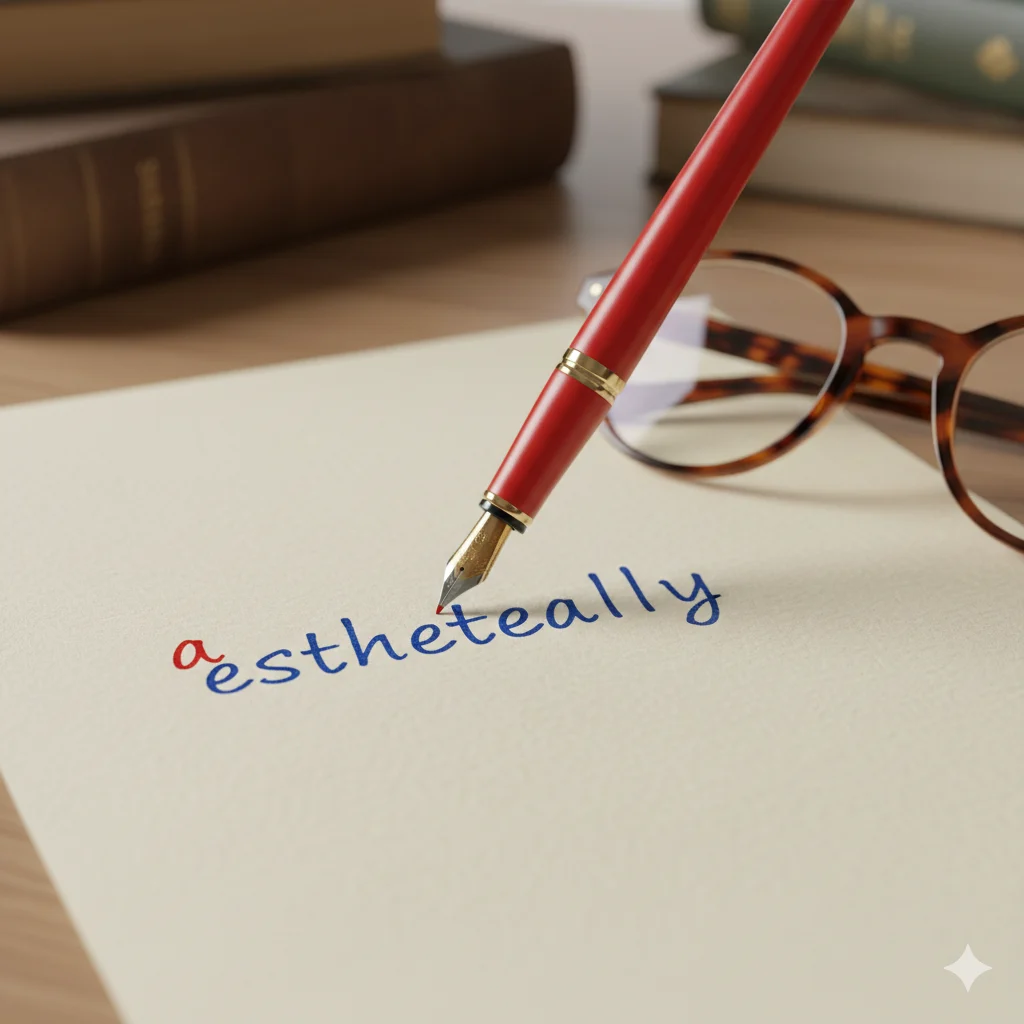
- Misspelling the “ae” cluster: Writing “eshetically” or “asthetically.” Incorrect: “The design was eshetically pleasing.” Correct: “The design was aesthetically pleasing.”
- Mixing dialects inconsistently: Using “aesthetic” and “esthetically” in the same document. Choose one variant and stick with it for consistency.
- Confusing with similar words: It is not “ascetically” (which relates to strict self-discipline) or “anesthetically” (related to anesthesia). Remember the core link to beauty and art.
Aesthetically in Everyday Examples
Let’s see how to use it naturally in different contexts.
- Email/Professional: “We propose a redesign that is more aesthetically aligned with the modern brand.”
- Social Media (Instagram caption): “Found this aesthetically beautiful hidden café in Tarapoto! #wanderlust”
- News/Review: “The film is an aesthetically stunning masterpiece, every frame a painting.”
- Formal Writing: “The architect prioritized solutions that were both functional and aesthetically coherent.”
Aesthetically synonyms you can use include: artistically, pleasingly, gracefully, beautifully.

Aesthetically – Google Trends & Usage Data
Analysis of search data and corpora shows clear trends. Globally, the search volume for “aesthetically” is significantly higher than for “esthetically,” often by a factor of 5-to-1 or more. This dominance is consistent in almost all English-speaking countries outside the United States. In the US, searches for “aesthetically” still lead, but “esthetically” holds a notable share (around 20-30% of the combined searches), reflecting its established variant status. The phrase “aesthetically pleasing” is an extremely high-volume search term, indicating it’s the primary way users express this concept. Searches related to “aesthetically pronunciation” (often /es-ˈthe-ti-k(ə-)lē/) are also common, confirming this is a word people want to use correctly in speech and writing.
FAQs – Aesthetically vs. Esthetically
Q1: Is “esthetically” a real word?
Yes, “esthetically” is a recognized variant spelling of “aesthetically,” primarily used in American English.
Q2: Which spelling is more correct?
Both are correct within their respective dialects. “Aesthetically” is the original and more globally universal form.
Q3: Do dictionaries list both spellings?
Yes, major dictionaries list “aesthetic” as the primary entry, with “esthetic” noted as a variant, especially in American dictionaries.
Q4: How is “aesthetically” pronounced?
It is commonly pronounced as es-THET-ik-lee (emphasis on the second syllable). The “ae” is typically pronounced as a short “e” sound.
Q5: What does “aesthetically pleasing meaning” entail?
It describes something that is visually, artistically, or sensually beautiful and satisfying, appealing to a sense of taste and style.
Q6: What are some “aesthetically beautiful synonyms”?
Phrases like “visually stunning,” “artistically elegant,” “picturesque,” and “visually appealing” convey a similar meaning.
Q7: Should I use “aesthetic” or “esthetic” in my website’s SEO?
For broad reach, use “aesthetic.” If targeting a strictly US audience, you can include the “esthetic” variant, but “aesthetic” keywords generally capture more search volume universally.
Conclusion
In the debate of esthetically vs aesthetically, the winner is clarity and knowing your audience. The key takeaway is that “aesthetically” (with the “a”) is the globally standard and safest choice for international, academic, and formal communication. The simplified American variant “esthetically” is correct when writing specifically for a US audience. Remember the pattern: “ae” is classic and commonwealth, “e” is simplified American. Avoid common misspellings like “eshetically” by recalling the Greek root. Ultimately, whether you’re describing an aesthetically pleasing website, an aesthetically beautiful landscape in Tarapoto, or seeking the perfect aesthetically synonym, consistency is key. Choose the spelling that best fits your reader’s context, and your writing will not only be correct but also naturally polished and professional.