What’s in a name? When it comes to shapes and their names, a lot! Knowing the names of shapes is like learning the ABCs of the world around you. Every object, from a fluffy cloud to your phone, is made of shapes. Learning these names helps us describe, create, and understand our universe. It’s the first step in math, art, science, and design.
This guide is your one-stop shop for all things shaped. We’ll explore the simple shapes and their titles, the tricky 3D forms, and even the cool patterns in nature. You’ll quickly learn to spot a hexagon on a honeycomb or a cube in a gift box.
Ready to become a shape expert? Let’s dive into the wonderful world of geometric shapes and names!
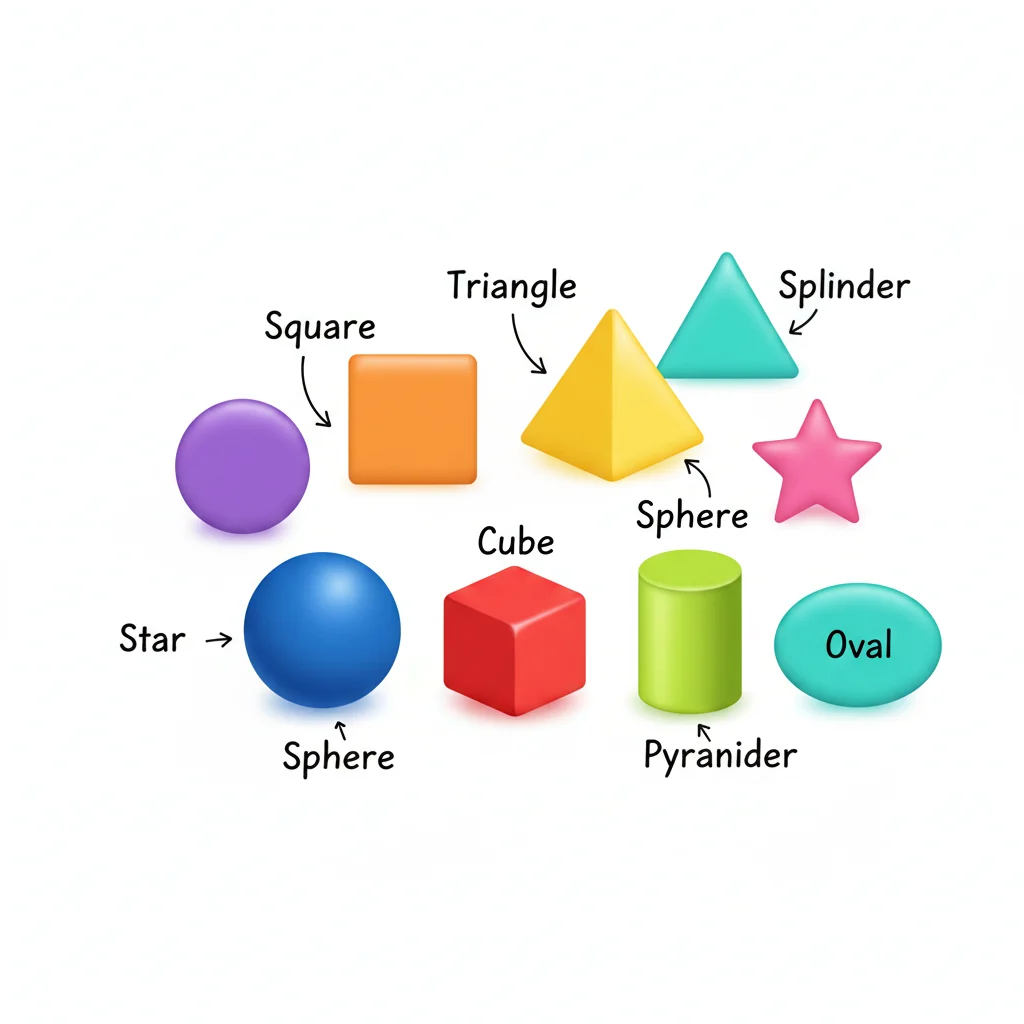
Basic 2D Shapes and Their Names
These are the flat figures you can draw on paper. They have only two dimensions: length and width.
Circle
- A perfectly round shape with no corners or edges, where every point is the same distance from the center.
- It suits things that roll or are smooth, like wheels, plates, and clocks.
Square
- A shape with four equal sides and four right angles (90-degree corners).
- It suits stable, strong things like windows, chess boards, and building blocks.
Triangle
- A three-sided polygon with three angles. It can be equilateral (all sides equal), isosceles, or scalene.
- It suits strong structures like pyramids, road signs, and slices of pizza.
Rectangle
- A shape with four sides and four right angles, where opposite sides are equal in length.
- It suits doors, sheets of paper, smartphones, and most books.
Oval (or Ellipse)
- A stretched-out circle or a rounded, elongated shape like an egg.
- It suits racetracks, mirrors, eggs, and the orbits of planets.
3D Shapes and Their Names
These are solid figures that have three dimensions: length, width, and height (or depth). They are not flat.
Cube
- A 3D shape with six identical square faces, twelve edges, and eight vertices (corners).
- It suits dice, sugar cubes, rubik’s cubes, and storage boxes.
Sphere
- A perfectly round 3D shape, like a ball, where every point on the surface is the same distance from the center.
- It suits planets, marbles, oranges, and soccer balls.
Cylinder
- A 3D shape with two parallel circular bases and a curved surface connecting them.
- It suits cans of soup, pencils, pipes, and drums.
Cone
- A 3D shape with a circular base that tapers smoothly to a point called the apex.
- It suits ice cream cones, traffic cones, party hats, and volcano shapes.
Pyramid
- A 3D shape with a polygon base and triangular faces that meet at a point (the apex). A square pyramid has a square base.
- It suits the ancient pyramids of Egypt, certain roof structures, and some gemstones.
Polygons: Many-Sided Shapes
Polygons are closed, 2D shapes made with three or more straight lines.
Pentagon
- A five-sided polygon. “Penta” means five.
- It suits the design of the U.S. Pentagon building and some soccer ball panels.
Hexagon
- A six-sided polygon. “Hexa” means six.
- It suits honeycomb cells in beehives, bolt heads, and floor tiles.
Octagon
- An eight-sided polygon. “Octa” means eight.
- It suits stop signs and some fountains or gazebo designs.
Decagon
- A ten-sided polygon. “Deca” means ten.
- It suits some coins, medallions, and decorative designs.
Shapes in Nature
Mother Nature is the best artist! Many shapes and their names are inspired by the world around us.
Spiral
- A curve that winds around a central point, getting farther away as it goes.
- It suits snail shells, galaxies (like the Milky Way), hurricanes, and unfurling ferns.
Hexagon in Honeycomb
- Bees build their wax cells in a perfect hexagonal grid. This shape uses space very efficiently.
- It is a perfect example of strong, efficient design in the animal kingdom.
Fractal
- A never-ending, infinitely complex pattern that looks similar at any scale. They are created by repeating a simple process.
- It suits snowflakes, mountain ranges, coastlines, and Romanesco broccoli.
Shapes in Everyday Objects
Look around! Your home is full of shapes. Knowing different shapes and their names helps you see the world in a new way.
Crescent
- A shape that looks like a thin, curved sliver of the moon.
- It suits croissants, the moon in its first phase, and some decorative symbols.
Star
- A shape, often with five or six points, that looks like the stars we see in the night sky.
- It suits starfish, Christmas tree toppers, and badges for achievements.
Heart
- A symbol representing love, with two rounded lobes at the top and a point at the bottom.
- It suits Valentine’s Day cards, emoticons, and decorative patterns.
Curved and Rounded Shapes
Not all shapes have straight lines. These ones are all about smooth curves.
Semi-Circle
- Exactly half of a circle, like a circle folded in two.
- It suits rainbows, arches over doors (Roman arches), and protractors for measuring angles.
Annulus (ANN-you-lus)
- A fancy name for a ring shape—the area between two circles of different sizes.
- It suits a washer (the metal ring), a doughnut (if you look from above), and a lifebuoy.
Crescent
- (As mentioned above) A great example of a curved shape from everyday life.
Mathematical and Geometric Shapes
These are the precise shapes you study in math class.
Rhombus
- A parallelogram where all four sides are equal in length, like a slanted square.
- It suits some diamonds on playing cards, kites, and certain road signs.
Trapezoid (TRAP-uh-zoid)
- A quadrilateral with at least one pair of parallel sides.
- It suits handbags, the side of a bridge, and some lampshades.
Parallelogram
- A quadrilateral with two pairs of parallel sides. Squares, rectangles, and rhombuses are all special types of parallelograms.
- It suits the tilted faces of a leaning building or certain tiles in a pattern.
Irregular and Organic Shapes
These shapes don’t follow strict geometric rules. They are often freeform and asymmetrical.
Blob / Amoeba Shape
- A freeform, irregular shape with curvy, unpredictable outlines.
- It suits puddles, clouds, ink blots, and the shape of a single living cell (an amoeba).
Organic Shape
- Shapes found in nature that are irregular and flowing, unlike perfect geometric shapes.
- It suits the shape of a leaf, a rock, a flame, or a country’s coastline on a map.
Shapes in Art and Design
Artists use shapes and their titles to create balance, interest, and meaning in their work.
Silhouette
- The dark shape and outline of someone or something, seen against a lighter background.
- It suits shadow puppets, profile portraits, and striking graphic designs.
Abstract Shape
- A shape that does not represent a real object but is used for its visual effect alone.
- It suits modern art, logo design, and decorative patterns.
Geometric Pattern
- A pattern made by repeating geometric shapes like circles, lines, and polygons.
- It suits wallpaper, fabric prints, Islamic art, and mosaic tiles.
Why Knowing Shapes and Their Names Matters
Learning shapes and their names is much more than a simple lesson. It’s a foundational skill. For young children, it builds vocabulary and helps them understand and describe their environment. For students, it’s the essential first step into geometry, physics, and engineering. For all of us, it sharpens our observation skills. When you can name the hexagon in a beehive or the cylinder in a building’s column, you see the hidden structure of the world. It connects math to nature, art to science, and learning to everyday life. So next time you look around, try to name the shapes you see. You’ll be amazed at how knowing these simple names makes the world a more interesting and understandable place!
Conclusion:
Knowing shapes and their names is like having a secret decoder for the world. It’s more than just a list of words—it’s a new way to look at everything. From the basic circle of your breakfast plate to the complex hexagons in a beehive, shapes are the building blocks of our universe.
This knowledge helps kids learn and describe their surroundings. It helps students unlock math and science. For all of us, it connects art, nature, design, and technology. When you know the names, you start to see patterns everywhere. You notice the cubes in architecture and the spirals in shells.
So, take a look around. Can you spot a cylinder, an oval, or a pyramid? Learning these names opens your eyes to the amazing design of everyday life. The world is full of shapes and their titles, just waiting for you to name them.
5 FAQ About Shapes and Their Names
1. What is the most common shape in nature?
The hexagon is very common because it is a strong and efficient shape, perfectly seen in honeycombs.
2. What is the difference between 2D and 3D shapes?
2D shapes are flat with only length and width, while 3D shapes are solid and have length, width, and height.
3. What is an 8-sided shape called?
An 8-sided shape is called an octagon, like a stop sign.
4. What shape has no corners?
A circle (in 2D) and a sphere (in 3D) have no corners or edges.
5. Why is it important to learn shapes?
Learning shapes helps with reading, math, describing objects, and understanding the world around us.