Do you want a new ear piercing? The many names of ear piercings can be confusing. This simple guide explains them all.
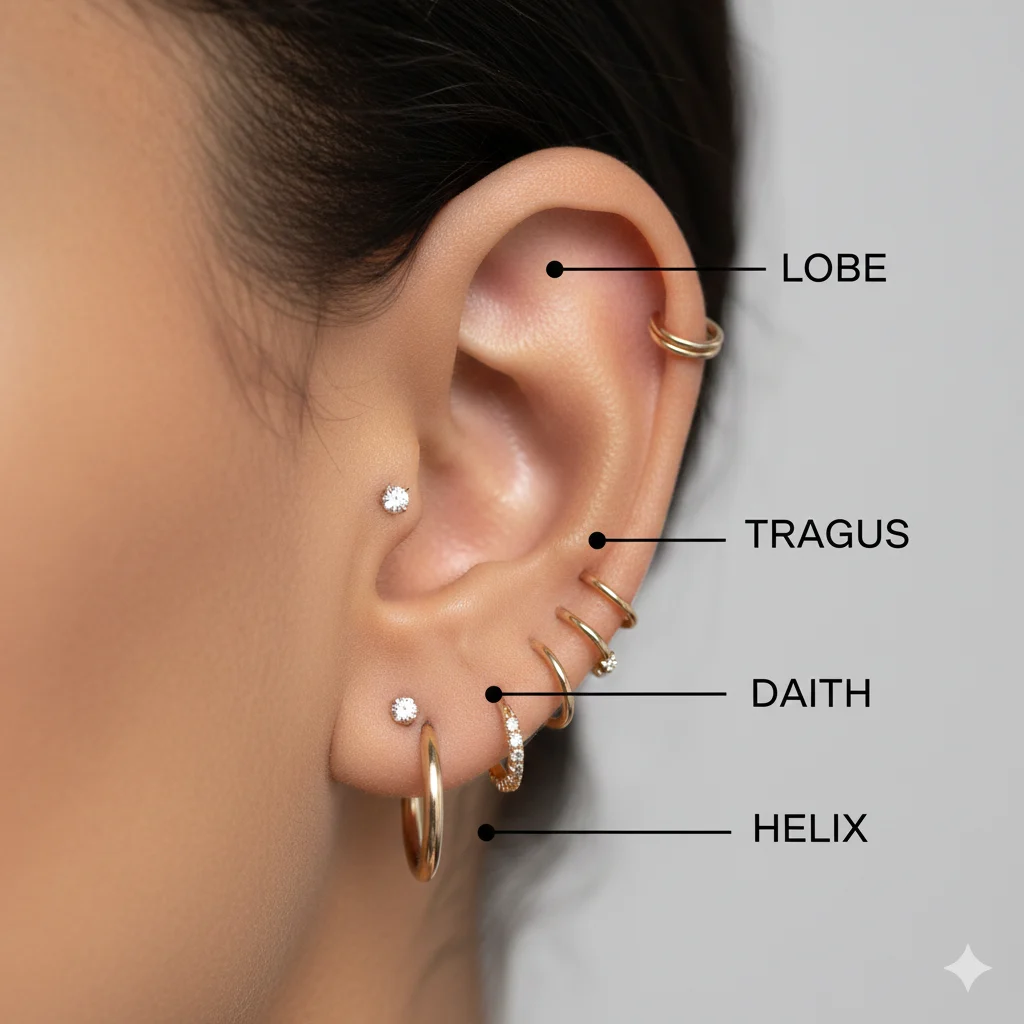
The names of ear piercings come from the part of the ear they are on. Knowing these names helps you get the exact look you want.
Your ear is like a map. Each area has a name. Piercing names tell you the location on that map. We will list all the common ear piercing names. This helps you plan a cool and stylish ear.
Lobe Piercings
The classic and most popular spot.
Standard Lobe
This is the soft, fleshy bottom part of your ear. It is the most common first piercing. It heals quickly.
- Best for: Everyone, especially first-timers. You can wear studs, hoops, or dangly earrings here.
Stacked Lobe
This means having multiple lobe piercings placed up and down the earlobe, not just in the center.
- Best for: People who love lots of jewelry and a trendy, curated look.
Helix Family
Piercings along the upper ear rim.
Helix
This is on the outer upper rim of your ear cartilage. It’s a very popular cartilage choice.
- Best for: A simple, cool stud or hoop on the top of your ear.
Forward Helix
This sits on the front part of the helix rim, closer to your face.
- Best for: A delicate, petite stud that adds detail to the front of your ear.
Double/Triple Helix
This means getting two or three helix piercings in a row along the rim.
- Best for: Creating a line of sparkle or multiple hoops for a bolder style.
Industrial Piercing
A bold, statement bar.
Industrial
This is two separate piercings—usually a forward helix and a standard helix—connected by one long barbell.
- Best for: Someone who wants an edgy, standout look. It requires patience to heal.
Tragus & Anti-Tragus
Piercings on the small cartilage bumps.
Tragus (TRAY-gus)
This goes through the small, thick flap of cartilage that pokes out in front of your ear canal.
- Best for: People who want a unique central stud. The cartilage is dense, so it can feel like a strong pinch.
Anti-Tragus
This is placed on the smaller bump of cartilage directly across from the tragus, above the lobe.
- Best for: Those with a prominent anti-tragus who want a less common, cool piercing.
Conch Piercing
The centerpiece of the ear.
Conch (KONCH)
Named after a seashell, this is in the large, cup-shaped center of your ear.
- Best for: A stunning focal point. A stud shines in the inner conch, while a hoop wraps beautifully around the outer conch.
Daith Piercing
The inner fold mystic.
Daith (DAYTH)
This piercing goes through the innermost fold of cartilage, right above the ear canal.
- Best for: A unique and somewhat hidden look. It’s often done with a captive bead ring or decorative hoop.
Rook Piercing
A hidden inner fold barbell.
Rook
This is a vertical piercing through the thick fold of cartilage between the inner and outer conch.
- Best for: People with a defined rook fold who like the idea of a hidden barbell that peeks out.
Snug Piercing
The challenging inner ridge.
Snug
This horizontal piercing goes through the inner anti-helical ridge (the raised inner rim of cartilage).
- Best for: Experienced piercing enthusiasts ready for a tougher heal and a very distinctive placement.
Flat Piercing
Your ear’s tiny art gallery.
Flat
This is on the flat plane of cartilage between the helix rim and the inner conch. It’s a smooth canvas.
- Best for: Showcasing beautiful cluster studs, tiny stars, or other decorative designs.
Auricle Piercing
The perfect mid-ear hoop spot.
Auricle (OR-ih-kul)
This is placed on the curved cartilage shelf between the lobe and the helix.
- Best for: Someone who dreams of a perfect mid-ear hoop once the piercing is fully healed.
FAQs About Names of Ear Piercings
Q: Which piercing names are the most painful?
A: Pain is personal, but piercings through thicker cartilage (like snug, rook, and anti-tragus) are often reported as more painful than the lobe or helix.
Q: How long until I can change my jewelry?
A: Healing times vary. Lobes: 6-8 weeks. Cartilage (helix, conch, etc.): 6-12 months. Never change jewelry too early; let your piercer guide you.
Q: What does “curated ear” mean?
A: It means thoughtfully combining different names of ear piercings over time to create a personal, artistic arrangement on your ear.
Q: Can I get multiple piercings at once?
A: Often, yes, but it depends on your pain tolerance and healing ability. A good piercer will advise you, usually suggesting no more than 3-4 healing at once.
Q: How do I choose my next piercing?
A: Look at your ear’s shape, consider your pain tolerance and healing commitment, and think about the final look you want. Your professional piercer can give the best advice.
Conclusion
Understanding the names of ear piercings is the first step to expressing your personal style. From the simple lobe to the intricate snug, each name opens up a new possibility for decoration. Use this guide to explore your options, communicate clearly with a professional piercer, and build a look that is uniquely you. Always prioritize safety by choosing a reputable studio and following aftercare instructions carefully. Enjoy creating your own masterpiece!

Norman Lewis was a British writer famed for his brilliant travel journalism, sharp cultural insight, and classics like Naples ’44 and Voices of the Old Sea.