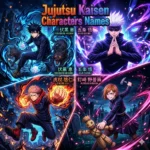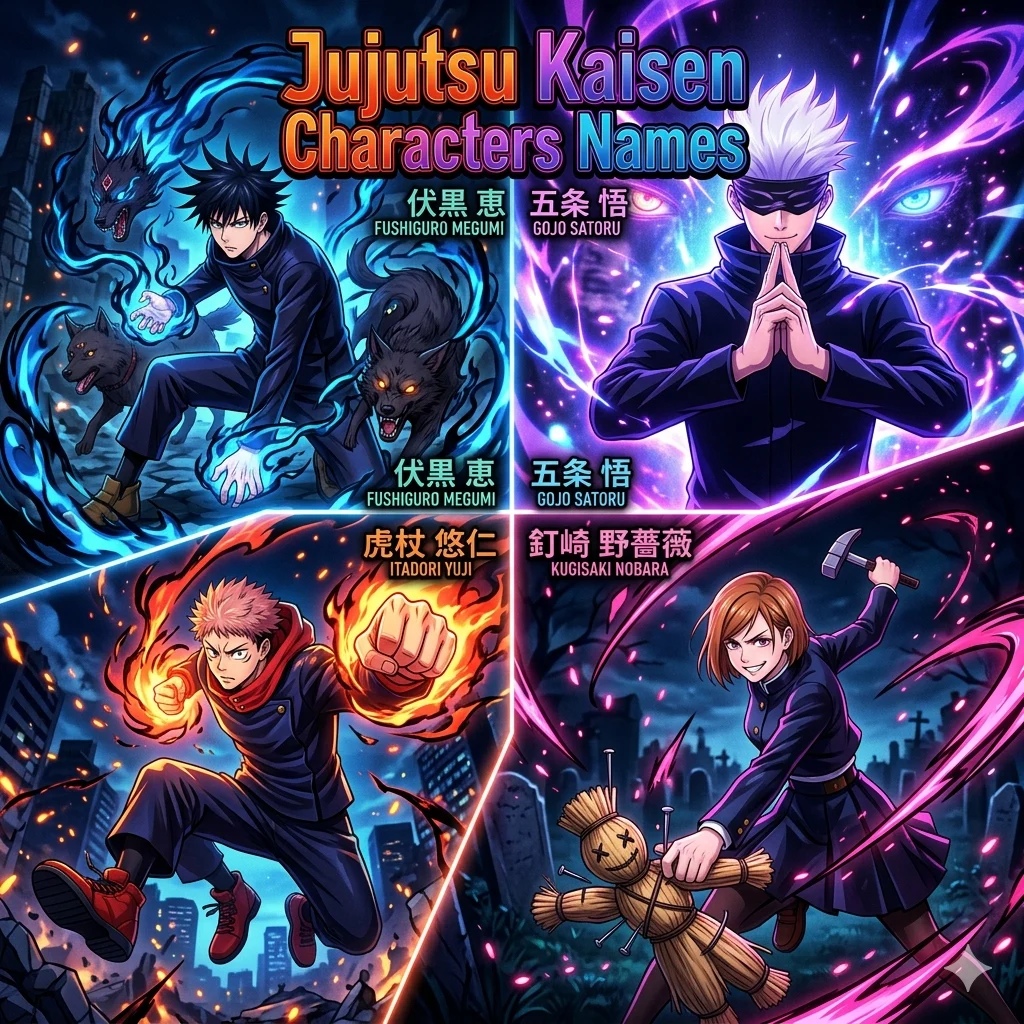
If you have ever watched Jujutsu Kaisen and struggled to remember a character’s name — or worse, mispronounced it in front of a fellow fan — you are not alone. From tongue-twisting names like Ryomen Sukuna to deceptively simple ones like Yuta, the anime jujutsu kaisen characters names are rich in Japanese history, mythology, and hidden meanings.
This is your ultimate guide to all jujutsu kaisen characters names — boys, girls, villains, sorcerers, and cursed spirits — complete with correct pronunciations, kanji meanings, affiliations, abilities, and the mistakes fans most commonly make.
Whether you are a new viewer, a seasoned manga reader, a cosplayer, or simply building your jujutsu kaisen character names list, this guide covers everything in one place.
Why Jujutsu Kaisen Character Names Are So Special
Most anime use standard Japanese names. JJK goes further — the character naming conventions in jujutsu kaisen are deeply intentional. Names are drawn from real Japanese mythology and folklore (Ryomen Sukuna is an actual historical demon), classical kanji meanings that reflect a character’s power or personality, historical figures like Sugawara no Michizane who is a real deified scholar, and ironic naming — Mahito means “true person” yet he is the villain who destroys human souls.
Understanding jujutsu kaisen character naming conventions reveals layers of storytelling that casual viewers miss entirely.
The Names Fans Always Get Wrong (Pronunciation Guide)
Before diving into the full list, here are the most commonly mispronounced jujutsu kaisen names — with corrections:
| Name | Wrong | Correct | Quick Tip |
|---|---|---|---|
| Sukuna | “SOO-koo-na” | “soo-KOO-nah” | Stress the second syllable |
| Megumi | “MEG-yoo-mee” | “meh-GOO-mee” | No “y” sound at all |
| Utahime | “You-tah-hime” | “OO-tah-hee-meh” | Four clean equal syllables |
| Inumaki | “IN-you-maki” | “ee-noo-MAH-kee” | Starts with “ee” not “in” |
| Kenjaku | “KEN-ja-kew” | “ken-JAH-koo” | Final “u” is short |
| Choso | “CHOSE-oh” | “CHOH-soh” | Two equal syllables |
| Yuta | “YOU-ta” | “YOO-tah” | Soft, round, clean sound |
| Kokichi | “KOH-kee-chee” | “koh-KEE-chee” | Stress the middle syllable |
All Male JJK Characters Names (Boy Names from Jujutsu Kaisen)
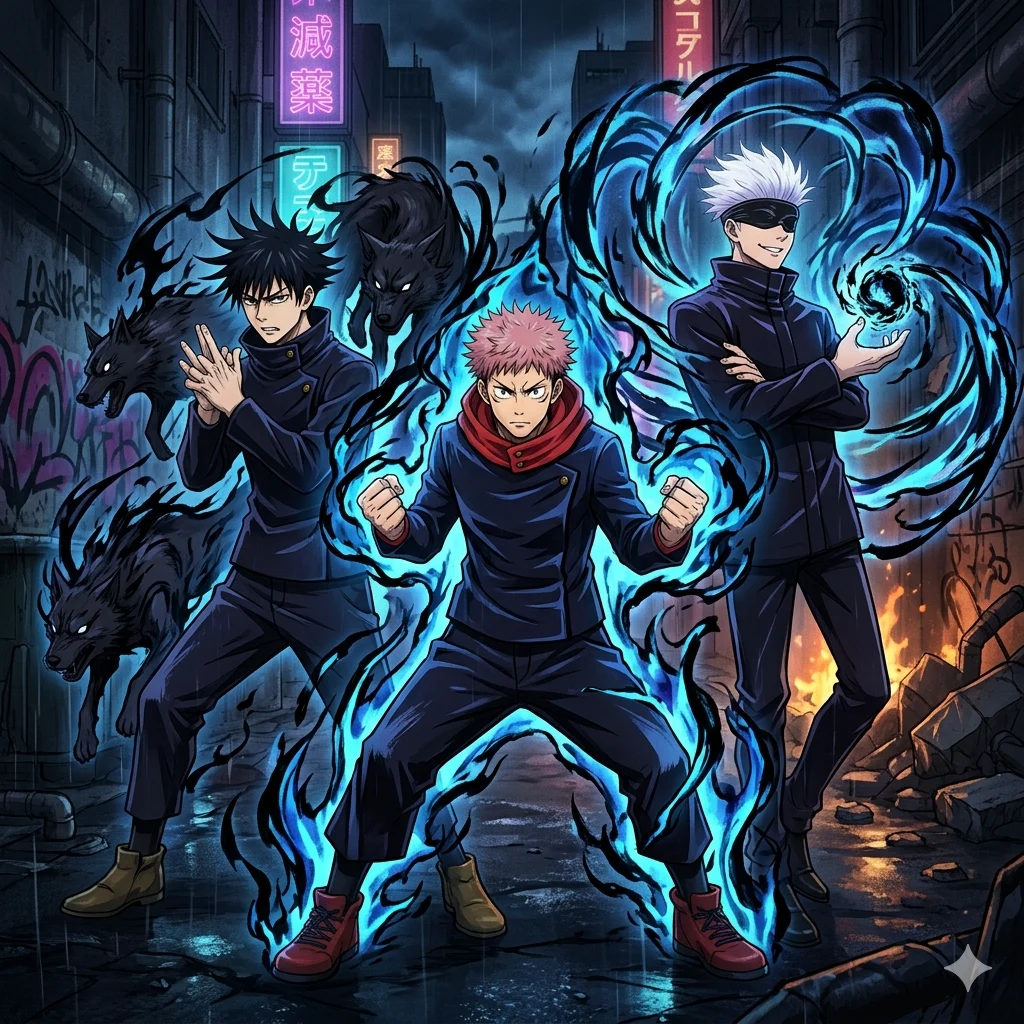
Main Male Characters
Yuji Itadori (YOO-jee ee-tah-DOH-ree)
- Kanji meaning: “Courageous second son” — Itadori refers to a Japanese knotweed plant
- Affiliation: Tokyo Jujutsu High, Grade 1 Special
- Ability: Divergent Fist, Black Flash, host body of Ryomen Sukuna
- Personality: Kind-hearted, physically exceptional, deeply empathetic
- Fan mistake: Calling him just “Itadori” is technically correct by Japanese convention (family name first), but many Western fans reverse this and accidentally call him “Yuji Itadori” surname-first, which is the reverse order
- Best for: A relatable everyman hero placed in extraordinary circumstances
Megumi Fushiguro (meh-GOO-mee foo-shee-GOO-roh)
- Kanji meaning: Megumi = “blessing”; Fushiguro = “black haired / dark complexioned”
- Affiliation: Tokyo Jujutsu High, Grade 2 (later Special Grade)
- Ability: Ten Shadows Technique — summons divine shikigami including Divine Dogs, Nue, and the catastrophic Mahoraga
- Personality: Calm, strategic, morally complex, fiercely protective of those he chooses
- Fan mistake: Treating Megumi as exclusively a girl’s name — it is a traditional unisex Japanese name, and in the series it belongs to a male character
- Best for: A protector whose power and name are both literally about blessing and guarding others
Satoru Gojo (SAH-toh-roo GOH-joh)
- Kanji meaning: Satoru = “enlightened, one who understands truth”; Gojo = “five paths” (五条)
- Affiliation: Tokyo Jujutsu High, Special Grade — widely acknowledged as the strongest sorcerer alive
- Ability: Infinity (Limitless Cursed Technique), Six Eyes, Hollow Purple, Blue, Red
- Personality: Playful, confident to the point of arrogance, genuinely the most powerful — and he knows it
- Fan mistake: Pronouncing it “gah-JO” — the correct form is “GOH-joh” with equal weight on both syllables
- Why meaningful: “Satoru” meaning enlightened perfectly suits the only sorcerer who truly sees cursed energy at its most fundamental level
Suguru Geto (soo-GOO-roo GEH-toh)
- Kanji meaning: Suguru = “excel, surpass”; Geto carries archaic connotations of the foreign or arcane
- Affiliation: Former Tokyo Jujutsu High student; later leader of a cursed spirit cult
- Ability: Cursed Spirit Manipulation — can absorb and weaponize any cursed spirit he defeats
- Personality: Charismatic, philosophical, deeply tragic — a fallen idealist who chose the wrong answer to a real question
- Fan mistake: Confusing him with Kenjaku, who later inhabits his body. They are entirely different entities sharing a face.
- Best for: A dark mage or cult leader archetype — brilliant, genuinely caring once, then corrupted
Kenjaku (ken-JAH-koo)
- Kanji meaning: A historical sorcerer name — exists across centuries by transplanting his brain into new bodies
- Affiliation: Mastermind villain operating across multiple historical eras
- Ability: Body-swapping; can use all techniques belonging to the bodies he inhabits
- Personality: Ancient, patient, cold — manipulates entire generations as chess pieces
- Fan mistake: Thinking Kenjaku equals Geto. He wears Geto’s body but they share nothing beyond a face.
- Best for: An immortal scheming villain who has shaped history from the shadows for centuries
Nanami Kento (nah-NAH-mee KEN-toh)
- Kanji meaning: Nanami = “seven seas” (七海); Kento = “fist of principle” suggesting moral strength
- Affiliation: Tokyo Jujutsu High, Grade 1 Sorcerer
- Ability: Ratio Technique — creates a mandatory weak point at the 7:3 ratio of any object
- Personality: Professional, principled, deeply humane — openly dislikes overtime and genuinely means it
- Best for: A reliable, no-nonsense mentor with quiet depth that only reveals itself under pressure
Aoi Todo (AH-oh-ee TOH-doh)
- Kanji meaning: Aoi = “blue” or “hollyhock flower”; Todo = “ferocious war”
- Affiliation: Kyoto Jujutsu High, Grade 1 Sorcerer
- Ability: Boogie Woogie — swaps positions of anything containing cursed energy with a single clap
- Personality: Loud, passionate, obsessed with strong women and Takada-chan — conceals a genuinely brilliant tactical mind
- Fan mistake: Dismissing him as comic relief. Todo is among JJK’s most effective fighters and one of its sharpest minds.
- Best for: A character who combines wild passion with unexpected tactical depth
Toge Inumaki (TOH-geh ee-noo-MAH-kee)
- Kanji meaning: Toge = “enclosure” or “valerian plant”; Inumaki = clan name meaning “dog roll / barking”
- Affiliation: Tokyo Jujutsu High, Semi-Grade 1 Sorcerer
- Ability: Cursed Speech — his words become compulsory commands. He communicates only through rice ball ingredients to prevent accidents.
- Personality: Quiet, restrained, conscientiously protective — bears enormous responsibility with complete composure
- Best for: A silent character whose power literally is his voice — a beautiful irony
Toji Fushiguro (TOH-jee foo-shee-GOO-roh)
- Kanji meaning: Toji = “winter solstice” — the darkest point before light returns
- Affiliation: Former Zenin clan, later freelance assassin; Megumi’s biological father
- Ability: Zero cursed energy — invisible to cursed spirit detection; compensates with superhuman physical ability and mastery of cursed tools
- Personality: Cold, mercenary, irredeemably selfish — except for one moment, one choice, regarding Megumi
- Fan mistake: Underestimating him because he has no cursed technique. Toji Fushiguro nearly killed Satoru Gojo.
- Why important: One of JJK’s most haunting characters — a man whose greatest strength is also his greatest isolation
Yuta Okkotsu (YOO-tah oh-KOH-tsoo)
- Kanji meaning: Yuta = “gentle, abundant” or “brave person”; Okkotsu is a rare family name
- Affiliation: Tokyo Jujutsu High, Special Grade Sorcerer
- Ability: Rika (immensely powerful bound cursed spirit); Copy technique — duplicates any cursed technique he has witnessed
- Personality: Initially timid and consumed by guilt; grows into one of the most formidable sorcerers in the series
- Best for: A gentle soul carrying overwhelming power — haunted by love and loss in equal measure
Kinji Hakari (KIN-jee ha-KAH-ree)
- Kanji meaning: Hakari = “scales / calculation / gambling”; Kinji = “golden second”
- Affiliation: Tokyo Jujutsu High Grade 1 (suspended at series start)
- Ability: Idle Death Gamble — a domain expansion based on pachinko probability that grants near-immortality during a jackpot
- Personality: Self-assured, reckless, motivated by profit and the thrill of high stakes
- Best for: A risk-taker whose power is literally mathematical luck
Choso (CHOH-soh)
- Kanji meaning: “Eldest blood painting” — refers directly to his origin as a Death Painting Womb
- Affiliation: Initially Kenjaku’s side; later aligned with Yuji out of genuine brotherly feeling
- Ability: Convergence and Flowing Red Scale — blood manipulation at an expert level
- Personality: Ancient, calm, fiercely devoted to his brothers — family loyalty is his entire identity
- Fan mistake: Calling him a cursed spirit. He is a hybrid — half-human, half-cursed spirit.
- Best for: A tragic, powerful figure driven entirely by familial bonds
Junpei Yoshino (JOON-pay yoh-SHEE-noh)
- Kanji meaning: Junpei = “pure peace” — a name of devastating irony
- Affiliation: None formally; befriended by Yuji and then manipulated by Mahito
- Ability: Shikigami summoning (Moon Dregs)
- Personality: Kind, bullied, desperately lonely — one of JJK’s most tragic figures
- Best for: A relatable everyday teen who never had a chance
Villain Male Characters
Ryomen Sukuna (ree-OH-men soo-KOO-nah)
- Kanji meaning: Ryomen = “two-faced / both sides”; taken directly from real Japanese historical texts describing a feared demon with two faces and four arms
- Affiliation: The King of Curses — allegiance to no one
- Ability: Dismantle, Cleave, Malevolent Shrine (domain), fire arrow — among the most powerful techniques ever depicted
- Personality: Arrogant, amused by carnage, genuinely delighted by strength — respects only power
- Fan mistake: Treating Sukuna as a typical anime villain. He is a figure from real Japanese legend — the Nihon Shoki (720 AD) records him. His name carries over a thousand years of weight.
- Best for: The ultimate villain — a being so powerful that his name literally became legend
Mahito (mah-HEE-toh)
- Kanji meaning: “True person” or “saint” — deeply ironic for a villain who reshapes and destroys human souls
- Affiliation: Pseudo-Geto’s cursed spirit group
- Ability: Idle Transfiguration — touches a soul directly and reshapes the body in any form he chooses
- Personality: Childlike curiosity about human suffering — sees humans as philosophical material, not beings
- Fan mistake: Thinking he is simply evil. Mahito is a cursed spirit born entirely from human hatred of other humans — he is what people feel about each other, given form.
- Best for: A villain whose horror is philosophical, not merely physical
Jogo (JOH-goh)
- Kanji meaning: From “Jōgō” — passion, burning desire
- Affiliation: Pseudo-Geto’s group
- Ability: Disaster Flames — volcanic and fire attacks; his domain fills entirely with magma
- Personality: Fiery, impatient, intensely proud — deeply envious of humans despite considering them inferior
- Best for: A creature of pure elemental rage
Dagon (DAY-gon)
- Origin: From Philistine mythology — a Semitic fish deity, adding non-Japanese ancient myth to JJK’s world
- Affiliation: Pseudo-Geto’s group
- Ability: Disaster Tides — sea creature and water manipulation; Horizon of the Captivating Skandha domain
- Best for: An ancient, sea-territory ruler whose power is domain-based and overwhelming
Supporting Male Characters
Panda (PAN-dah)
- Origin: Literally the animal — a joke that becomes genuinely meaningful
- Affiliation: Tokyo Jujutsu High, Grade 2
- Ability: Three cores — switches between Panda, Gorilla, and a secret third form with vastly different abilities
- Personality: Surprisingly wise, warm, one of JJK’s most emotionally intelligent characters
- Fan mistake: Assuming he is comic relief. Panda’s philosophical depth rivals any human character in the series.
Hajime Kashimo (HAH-jee-meh kah-SHEE-moh)
- Kanji meaning: Hajime = “beginning / first” — suggests foundations and origins
- Affiliation: Culling Game participant — an ancient sorcerer reincarnated
- Ability: Giga Breath — devastating lightning and electrical technique
- Personality: A pure warrior who returned to life with one goal: to fight Sukuna
Reggie Star (REH-jee)
- Origin: A Western name used in a Japanese sorcery context — deliberately anachronistic
- Affiliation: Culling Game participant
- Ability: Contractual Re-creation — materializes anything he holds a receipt for
- Personality: Calculated, business-like, oddly charming — completely out of place in his own world
- Best for: A character who doesn’t fit the naming patterns of his world
All Female JJK Characters Names (Girl Names from Jujutsu Kaisen)
Nobara Kugisaki (noh-BAH-rah koo-gee-SAH-kee)
- Kanji meaning: Nobara = “wild rose” — fierce beauty with thorns; Kugisaki = “nail cape”
- Affiliation: Tokyo Jujutsu High, Grade 3 (rapidly advancing)
- Ability: Straw Doll Technique — hammers nails through effigies and her own body to attack targets remotely
- Personality: Blunt, stylish, fiercely proud of her rural roots — refuses to be underestimated by anyone
- Fan mistake: Dismissing her technique as weak. Her straw doll method is one of the most creatively brutal in the series — she once used it against Mahito by exploiting his shared soul with Yuji.
- Best for: A strong-willed female lead who breaks every expected stereotype
Maki Zenin (MAH-kee ZEH-neen)
- Kanji meaning: Maki = “flourishing / true tree”; Zenin = the name of one of JJK’s most powerful and most toxic clans
- Affiliation: Tokyo Jujutsu High; exiled from the Zenin clan
- Ability: Near-zero cursed energy (like Toji) — compensated by superhuman physical strength and mastery of cursed tools
- Personality: Fierce, independent, driven entirely by the desire to prove the Zenin clan wrong about her worth
- Fan mistake: Confusing her with her twin Mai — they are profoundly different in personality and motivation
- Best for: A warrior who overcomes every disadvantage through sheer, unrelenting will
Utahime Iori (OO-tah-hee-meh ee-OH-ree)
- Kanji meaning: Utahime = “song princess” or “diva”; Iori = “thatched hermitage” suggesting hidden depth beneath a traditional exterior
- Affiliation: Kyoto Jujutsu High, Semi-Grade 1 Sorcerer and school supervisor
- Ability: Solo Solo Kinship — a song-based technique that amplifies the power of all allied sorcerers who hear it
- Personality: Elegant, strict, frequently exasperated by Gojo — holds herself and others to high standards
- Best for: A graceful mentor figure whose power exists to lift everyone around her
Mei Mei (MAY MAY)
- Kanji meaning: Repeated character meaning “bright” or “every”
- Affiliation: Independent Grade 1 Sorcerer who sells her services to the highest bidder
- Ability: Black Bird Manipulation — controls crows with cursed energy; Bird Strike kamikaze technique
- Personality: Sleek, calculating, unapologetically motivated by money — one of JJK’s most refreshingly honest characters
- Fan mistake: Underestimating her because she seems mercenary. Mei Mei is extraordinarily powerful and has survived encounters that killed others.
- Best for: A powerful, self-interested character who operates entirely on her own clearly stated terms
Shoko Ieiri (SHOH-koh ee-eh-EE-ree)
- Kanji meaning: Shoko = “child of clarity” or “rising child”
- Affiliation: Tokyo Jujutsu High — the school’s doctor
- Ability: Reverse Cursed Technique healing — one of only three sorcerers in the world able to heal others
- Personality: Cool, unflappable, perpetually smoking, deeply competent — never panics under any circumstances
- Best for: A calm, essential support character who holds everything together without drama
Riko Amanai (REE-koh ah-mah-NAH-ee)
- Kanji meaning: Riko = “child of truth” or “jasmine child”
- Affiliation: Star Plasma Vessel — destined to merge with Master Tengen
- Personality: Cheerful, brave, deeply human — which makes her fate devastating
- Best for: A pivotal character whose existence is the axis around which a major story arc turns
Yuki Tsukumo (YOO-kee tsoo-KOO-moh)
- Kanji meaning: Yuki = “snow” or “happiness”; Tsukumo = “ninety-nine spirits” — vast and mysterious
- Affiliation: Special Grade Sorcerer, operates entirely independently
- Ability: Garuda shikigami; Star Rage — adds virtual mass to herself for devastating physical force
- Personality: Free-spirited, philosophically driven, answers to no authority
- Best for: A wanderer with immense power who follows only her own path
Kirara Hoshi (kee-RAH-rah HOH-shee)
- Kanji meaning: Kirara = “sparkle / glitter”; Hoshi = “star”
- Affiliation: Culling Game participant
- Ability: Love Rendezvous — card suit-based technique creating magnetic attraction and repulsion effects
- Personality: Flashy, protective, devoted to Hakari
- Best for: A stylish character whose power literally shines
Unisex and Unique JJK Character Names
Uraume (oo-ROW-meh)
- Kanji meaning: “Plum rain” — a poetic Japanese seasonal term for the rains that fall when plums ripen
- Affiliation: Devoted servant of Ryomen Sukuna across centuries
- Ability: Frost Calm — extreme ice manipulation
- Personality: Ancient, utterly loyal, androgynously cold — emotion exists only in relation to Sukuna
- Best for: An immortal devoted servant with icy precision and quiet menace
Rika Orimoto (REE-kah oh-ree-MOH-toh)
- Kanji meaning: Rika = “fragrance of flowers” or “true fragrance”
- Affiliation: Bound to Yuta Okkotsu as a cursed spirit
- Ability: Immense cursed energy — as Queen of Curses she can grant Yuta nearly any technique he needs
- Personality: Loving, protective, terrifyingly possessive — her love for Yuta is simultaneously her power and her tragedy
- Best for: A benevolent spirit transformed into a monstrous, loving guardian
JJK Surnames — Complete Family Names List
| Surname | Notable Members | Clan Type |
|---|---|---|
| Itadori | Yuji, Wasuke | Civilian |
| Fushiguro | Megumi, Toji | Originally Zenin |
| Gojo | Satoru | Three Great Families |
| Zenin | Maki, Mai, Naoya, Toji (born) | Three Great Families |
| Kamo | Noritoshi | Three Great Families |
| Okkotsu | Yuta | Civilian |
| Inumaki | Toge | Sorcerer Clan |
| Kugisaki | Nobara | Civilian |
| Iori | Utahime | Sorcerer |
| Ieiri | Shoko | Civilian |
| Yoshino | Junpei | Civilian |
| Hakari | Kinji | Civilian |
| Tsukumo | Yuki | Special Grade |
| Hoshi | Kirara | Civilian |
| Hasaba | Mimiko, Nanako | Civilian |
JJK Character Naming Conventions for Sorcerers
The naming conventions in jujutsu kaisen follow several patterns that reveal character roles:
The Three Great Families (Gojo, Zenin, Kamo) use single-character surnames that feel ancient and weighted — like titles as much as names. Zenin literally means “garden entrance” but functions as a mark of both privilege and obligation. Gojo means “five paths” — fitting for a sorcerer whose technique bends the very pathways of cursed energy.
Characters with zero or near-zero cursed energy (Toji, Maki) often have names that ironically suggest power or flourishing — Toji means “winter solstice,” Maki means “true flourishing” — as though their names describe the potential their clan denied them.
Villain names frequently carry philosophical irony: Mahito means “true person” yet destroys souls. Kenjaku means something akin to “sword silence” yet is the loudest schemer in the series.
Mythical and Historical JJK Names
Ryomen Sukuna appears in the Nihon Shoki (720 AD) — Japan’s second oldest historical chronicle — as a feared demon with two faces and four arms who terrorized the land. Gege Akutami took this real historical figure and made him the King of Curses.
Sugawara no Michizane was a real 9th-century scholar, poet, and official who was deified after death as Tenjin, the god of scholarship and lightning. His appearance grounds JJK’s sorcery world in actual Japanese religious tradition.
Dagon comes uniquely from Philistine mythology — a Semitic deity associated with fish and the sea — adding non-Japanese ancient myth to JJK’s world.
Tengen (TEN-gen)
- Kanji meaning: “Heavenly origin” or “pivot of heaven”
- Affiliation: The immortal sorcerer who maintains barrier techniques protecting all of Japan
- Ability: Immortality (with periodic evolution), barrier techniques of continental scale
- Personality: Transcendent, detached — has existed so long that individual human identity has become abstract
- Best for: An ancient god-like being who has moved entirely beyond ordinary human experience
JJK Characters by Letter
JJK characters names that start with N: Nobara Kugisaki, Nanami Kento, Nanako Hasaba, Naoya Zenin, Noritoshi Kamo
JJK characters starting with R: Rika Orimoto, Riko Amanai, Reggie Star
JJK names that start with A: Aoi Todo, Atsuya Kusakabe
JJK characters that start with H: Hajime Kashimo, Hiromi Higuruma, Haibara Yu
JJK names that start with Y: Yuji Itadori, Yuta Okkotsu, Yuki Tsukumo, Yoshino Junpei
JJK Character Nicknames and Titles
| Character | Nickname / Title | Origin |
|---|---|---|
| Satoru Gojo | “The Strongest” / “Gojo-sensei” | Earned title and student address |
| Ryomen Sukuna | “King of Curses” | His own title, used across millennia |
| Yuta Okkotsu | “Special Grade Haunted One” | Early series description |
| Toge Inumaki | Speaks only in onigiri fillings | His speech restriction technique |
| Panda | Just “Panda” | His literal, actual name |
| Nobara Kugisaki | “Kugisaki-san” | Polite peer address |
| Nanami Kento | “Nanami-san” | Professional address — he insists on it |
JJK Season 2 Characters Names
Jujutsu Kaisen Season 2 introduced and expanded these key jujutsu kaisen characters names:
Suguru Geto is shown in his pre-villain idealist phase — the full arc of his fall becomes visible for the first time. Toji Fushiguro’s past mission and his connection to Gojo forms the core of Season 2’s first arc. Riko Amanai, the Star Plasma Vessel, is central to the Hidden Inventory arc — her fate is the pivot on which Geto’s entire story turns. Haibara Yu, a young sorcerer, appears briefly but permanently marks Nanami’s character. Season 2 also deepens the backstory of Mei Mei, Shoko Ieiri, and Utahime during their student years.
JJK OC Name Ideas (Original Character Names in JJK Style)
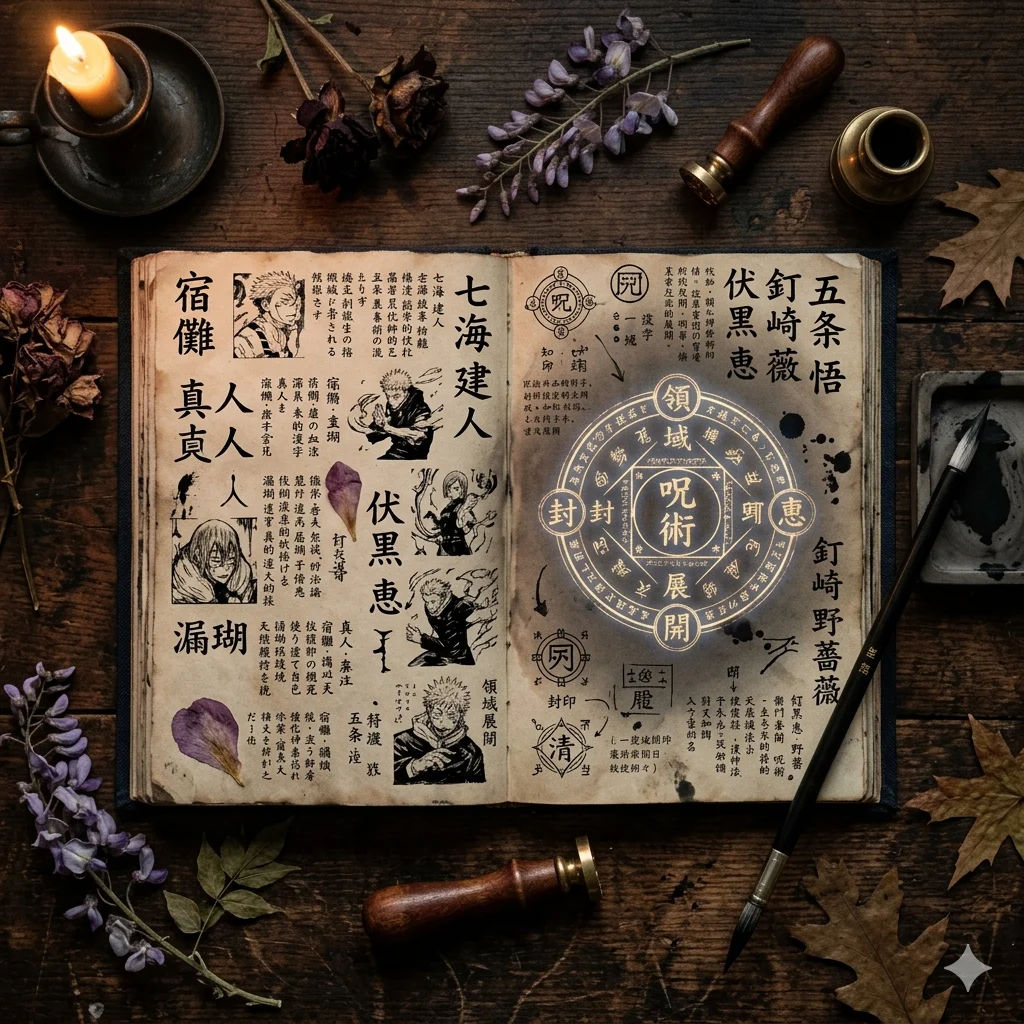
If you are creating an OC in the JJK universe, here is how jujutsu kaisen character naming conventions for sorcerers typically work.
For male jjk oc names, combine a nature or virtue kanji first name with a directional or elemental family name. Examples that feel authentic to the series: Haruki Nishimori, Ryota Kazemachi, Sora Minamoto, Tatsu Kurogane.
For female jjk oc names, flower or seasonal terms work beautifully as first names. Examples: Asahi Kurogane, Fuyu Takatsuki, Hotaru Arakawa, Saki Murasame.
For cool jjk surnames, traditional sorcerer families tend to use landscape or directional terms — Fushiguro (black haired / dark), Zenin (garden entrance), Gojo (five paths). Single-character surnames feel ancient and clan-like.
The most effective jjk oc name ideas follow the series’ irony pattern: pick kanji meanings that contradict or ironically load the character’s power. A fire-user named “Fuyu” (winter). A healer named “Toge” (thorn). This is exactly what Gege Akutami does with the main cast, and it rewards readers who notice.
Common Japanese Names in JJK Style
JJK deliberately mixes extraordinary characters with ordinary Japanese names to ground the series. Standard Japanese names that feel at home in JJK’s world: Haruto, Sota, Yuto, Ren, Kaito (boys) and Hana, Saki, Hina, Yui, Aoi (girls). These everyday names appear alongside mythological titles like Ryomen Sukuna — the contrast is intentional.
FAQS
What are the strongest jujutsu kaisen characters names? The definitively strongest are Ryomen Sukuna (King of Curses), Satoru Gojo (strongest living sorcerer), Yuta Okkotsu (Special Grade), and Yuki Tsukumo (Special Grade).
What are all the jujutsu kaisen characters names villains? Main villains include Ryomen Sukuna, Mahito, Suguru Geto (and Kenjaku wearing his face), Jogo, Dagon, Uraume, Naoya Zenin, and the Culling Game participants.
Do jujutsu kaisen character names have special meanings? Yes — almost every name carries kanji meaning that mirrors the character’s power, role, or ironic fate. Megumi means “blessing” and summons divine shikigami. Mahito means “true person” yet destroys souls. Satoru means “enlightened” and he literally sees cursed energy at its finest level.
What are jujutsu kaisen characters names in English pronunciation? See the pronunciation correction table at the top of this guide. The most commonly mispronounced are Sukuna, Megumi, Utahime, and Inumaki.
What are good jjk oc names? For boys: Haruki, Sora, Ryota combined with surnames like Nishimori or Kazemachi. For girls: Asahi, Fuyu, Hotaru with surnames like Kurogane or Arakawa. Follow JJK’s irony convention by choosing meanings that contrast with the character’s abilities.
What are jujutsu kaisen character name corrections fans need? The biggest corrections: Megumi is unisex not female. Kenjaku is not Geto — they share a body, not an identity. Toji Fushiguro has no cursed technique but is one of the series’ most dangerous characters. And “Ryomen Sukuna” is a real name from Japanese historical records, not invented for the anime.
Conclusion
The world of jujutsu kaisen characters names is one of anime’s most intentionally crafted naming systems. Every name carries kanji meaning, historical weight, or deliberate irony that deepens the story. From the mythologically grounded Ryomen Sukuna to the poetically named Yuki Tsukumo, from the tragically ironic Mahito to the perfectly descriptive Satoru Gojo — these are not decoration. They are layers of storytelling.
Whether you are building a jujutsu kaisen characters names list, searching for jjk oc name ideas, studying jujutsu kaisen character naming conventions, looking up jujutsu kaisen character name meanings, or simply trying to finally say “Utahime” correctly — every answer is in this guide.