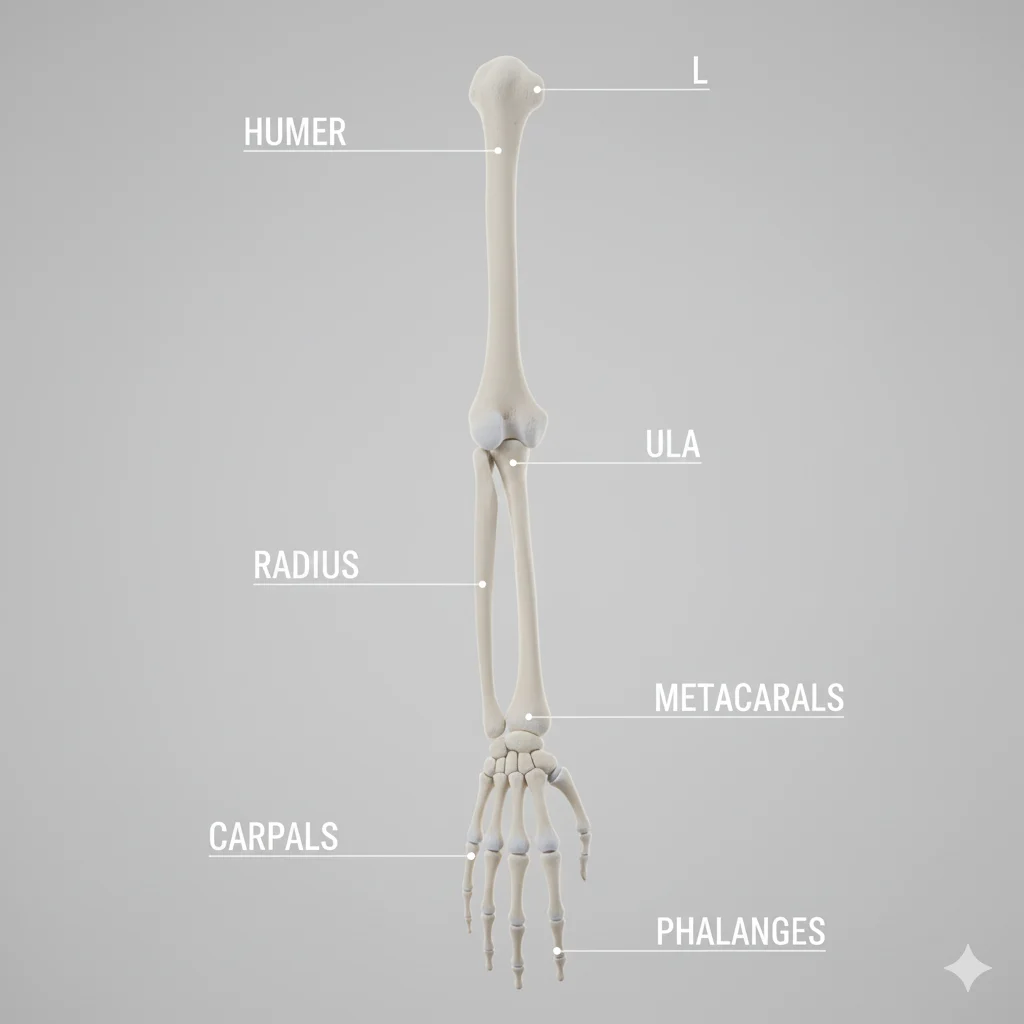
Do you know the names of all the bones in your arm? Learning the arm bone names is like getting a map to your own body. These bones are the framework that lets you wave, write, and hug. They have special names that often tell us about their shape or job. This guide will walk you through every single bone, from your shoulder to your fingertips. You will learn the names of the bones in the arm, what they do, and how they fit together. Let’s get started!
Your arm is made up of many bones. The main ones are the humerus in your upper arm, and the radius and ulna in your forearm. Your wrist and hand have lots of smaller bones called carpals, metacarpals, and phalanges. Knowing these arm bone names helps us understand how our amazing bodies work. It is useful for students, artists, athletes, or anyone who is curious. Let’s learn about each one!
The Humerus: Your Upper Arm Bone
The journey of arm bones starts at the shoulder. The humerus is the one and only bone of your upper arm. It is a long, strong bone.
- Name Meaning & Origin: The name “humerus” comes from Latin. Interestingly, it’s related to the word “humorous.” Some think it’s because the bone’s shape seemed funny, or because it’s near the “funny bone” nerve.
- Function & Connection: The top part connects to your shoulder blade in a ball-and-socket joint. This lets your arm rotate and swing in a circle. The bottom part connects with the two forearm bones to form your elbow joint.
The Forearm Duo: Radius and Ulna
Your forearm contains two long bones that work as a team. They allow your hand to rotate palm-up and palm-down.
The Radius: The Thumb-Side Bone
The radius is the forearm bone on the same side as your thumb. It is shorter and slightly thinner than the ulna.
- Position: It runs from the elbow to the wrist on the lateral side (thumb side).
- Special Job: When you turn your palm to face up (like holding soup), the radius rotates around the stationary ulna. This motion is called supination.
The Ulna: The Pinky-Side Bone
The ulna is the forearm bone on the same side as your pinky finger. It is the larger of the two forearm bones and forms the main point of your elbow.
- Position: It runs from the elbow to the wrist on the medial side (pinky side).
- Special Feature: It has a prominent hook-like part at the top called the olecranon process. This is the point of your elbow that you can feel and see.
The Wrist: A Cluster of Carpal Bones
The wrist is not just one bone. It is a complex group of eight small arm and hand bones called carpals. They are arranged in two rows of four.
- Function: These small bones give your wrist flexibility and strength. They act as a bridge between the long forearm bones and the bones of your hand.
- How to Remember Them: A common mnemonic to remember the carpal bone names is: “Some Lovers Try Positions That They Can’t Handle.” This stands for:
- Scaphoid
- Lunate
- Triquetrum
- Pisiform
- Trapezium
- Trapezoid
- Capitate
- Hamate
The Hand Framework: Metacarpal Bones
The palm of your hand is supported by five metacarpal bones. They are long bones that you can feel on the back of your hand.
- Numbering: They are numbered I to V, starting with the thumb (I) and ending with the pinky (V).
- Connection: One end connects to the carpal bones at the wrist. The other end forms the knuckles and connects to the finger bones.
The Fingers and Thumb: Phalanges
The bones of your fingers and thumb are called phalanges (singular: phalanx). Each finger has three phalanges, while the thumb has only two.
- Names: The three bones in each finger are called:
- Proximal Phalanx (closest to the palm)
- Middle Phalanx
- Distal Phalanx (at the fingertip)
- Thumb: The thumb lacks a middle phalanx, so it only has a proximal and a distal phalanx.
How the Arm Bones Connect: Joints and Movement
The arm bone names are important, but how they connect is what lets you move. The main joints are:
- Shoulder Joint: Where the humerus meets the shoulder blade. It has the greatest range of motion in the body.
- Elbow Joint: A hinge joint where the humerus, radius, and ulna meet. It allows bending and straightening.
- Wrist Joint: A complex joint where the radius and ulna meet the carpal bones.
- Finger Joints: Hinge joints between the phalanges.
Why Knowing Arm Bone Names Matters
You might wonder why learning these bones in the arm and their names is useful. Here are a few reasons:
- Health & Medicine: It helps you communicate clearly with doctors if you have pain or an injury.
- Fitness & Sports: Understanding your anatomy can improve your exercise form and prevent injuries.
- Art & Design: Artists, animators, and game designers need to know bone structure to draw or model realistic figures.
- Simple Curiosity: It’s fascinating to know how your own body is built!
Common Injuries to Arm Bones
Knowing the arm bone names can help you understand common injuries:
- Humerus: Can fracture from a hard fall.
- Radius & Ulna: Often broken together. A “Colles’ fracture” is a break at the wrist end of the radius.
- Scaphoid: The most commonly fractured carpal bone, usually from falling on an outstretched hand.
- Metacarpals: “Boxer’s fracture” is a break in the neck of the 5th metacarpal (pinky side).
Fun Facts About Arm Bones
- The humerus is the longest bone in the arm.
- Your “funny bone” isn’t a bone at all! It’s the ulnar nerve running over your elbow.
- Humans, birds, bats, and whales all have a humerus, radius, and ulna, showing our shared evolutionary history.
- At birth, a human has about 270 bones. By adulthood, some have fused, leaving 206. Many of those are in your hands and arms!
Visualizing the Arm Skeleton
It’s much easier to learn the arm bone names with a picture. Look for a labeled diagram of the arm skeleton. Try to trace the bones from your own shoulder down to your fingertips. Feeling them under your skin is the best way to learn!
Conclusion
Learning the arm bone names—from the mighty humerus to the tiny phalanges—gives you a deeper appreciation for the incredible design of the human body. These bones are not just a static framework; they are living, dynamic structures that allow us to interact with the world in countless ways. Whether you’re a student, an artist, an athlete, or simply someone fascinated by how things work, knowing this basic anatomy is powerful knowledge. So the next time you reach for a cup, throw a ball, or type on a keyboard, remember the complex and beautiful skeleton working silently to make it all possible.
(FAQ)
1. What are the 3 main arm bone names?
The three main bones are the humerus (upper arm), and the radius and ulna (forearm).
2. What is the funny bone actually called?
The “funny bone” sensation comes from the ulnar nerve, not a bone. It runs behind the end of the humerus bone at your elbow.
3. How many bones are in a human arm?
Each human arm contains 30 bones: 1 humerus, 1 radius, 1 ulna, 8 carpals, 5 metacarpals, and 14 phalanges.
4. What is the name of the shoulder blade bone?
The shoulder blade is called the scapula. It connects with the humerus bone to form the shoulder joint.
5. What are the wrist bone names called?
The eight wrist bones are called carpals. Their names are Scaphoid, Lunate, Triquetrum, Pisiform, Trapezium, Trapezoid, Capitate, and Hamate.